


-
1 of 253523 objects
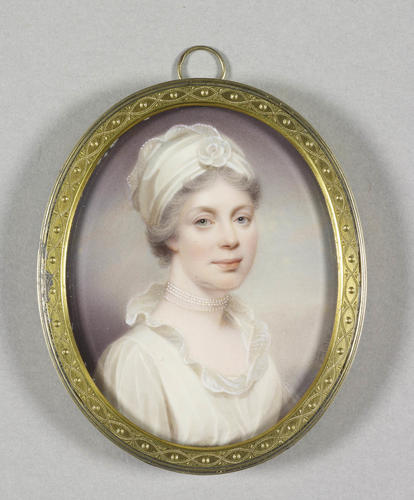
Henry Bone (1755-1834)
Queen Charlotte (1744-1818) Signed and dated 1801
Enamel on copper | 7.7 x 6.3 cm (support, canvas/panel/stretcher external) | RCIN 422429
-
Henry Bone was the son of a cabinet-make from Truro, Cornwall. Bone came to London c. 1779 and began to work as a miniature painter, at first painting in watercolour on ivory but working exclusively in enamel from c. 1803 onwards. After his appointment as Enamel Painter to George, Prince of Wales (later George IV) in 1801 he began to paint a series of large-scale enamel copies of mythological and religious paintings by Reynolds and the Old Masters which were elaborately framed and hung in the Prince of Wales's Private Bedroom at Carlton House. They survive as the most ambitious works of their type ever produced using the enamel technique.
Two versions of this miniature signed by Henry Bone, both painted in August 1801, are in the Royal Collection (421852 & 421672). The basis for all these copies is a miniature attributed to George Place at Stanton Harcourt Manor, believed to have been given to Lord Harcourt by Queen Charlotte. Place's miniature is thought to have been based upon an untraced prototype by Sir William Beechey which was later developed into known the full-length portrait exhibited RA 1797 (405423; Royal Collection). Many versions by Bone are known including those in the National Portrait Gallery, London (no. 6290) and the Victoria and Albert Museum, London (no. 944-1868).
Signed on the obverse along the lower right edge in brown paint: HBone and signed, dated and inscribed on the counter-enamel in black paint: Her Most Gracious / Majesty / Henry Bone pinx. / June 1801.Provenance
?Acquired by Queen Elizabeth the Queen Mother's Collection.
-
Creator(s)
-
Medium and techniques
Enamel on copper
Measurements
7.7 x 6.3 cm (support, canvas/panel/stretcher external)
7.8 x 6.5 x 0.6 cm (frame, external)
Other number(s)


