


-
1 of 253523 objects
Christian Daniel Rauch (1777-1857)
Victory 1851
Marble | 214.0 x 104.0 x 70.0 cm (whole object) | RCIN 41041
Grand Corridor Second Section, Osborne House

-
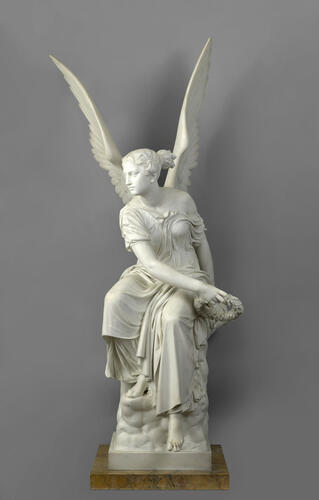
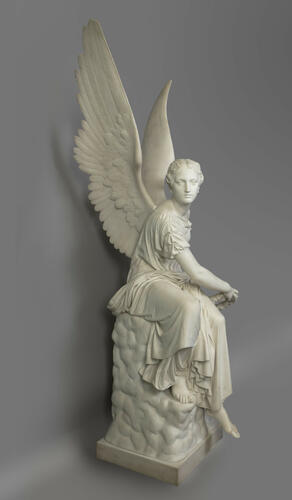
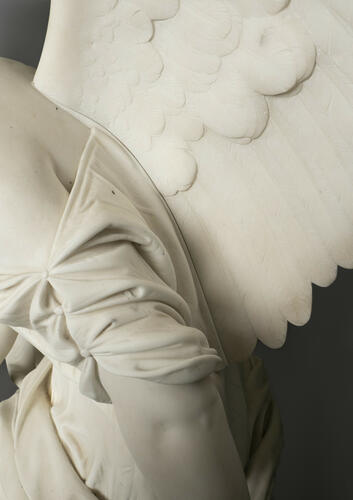
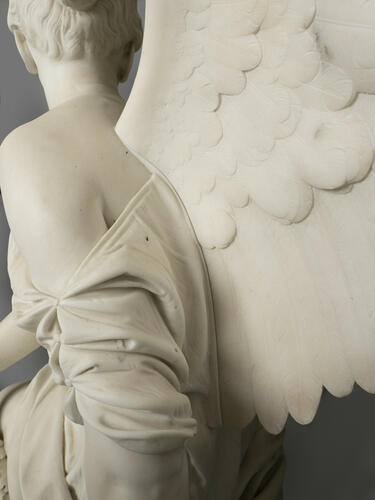
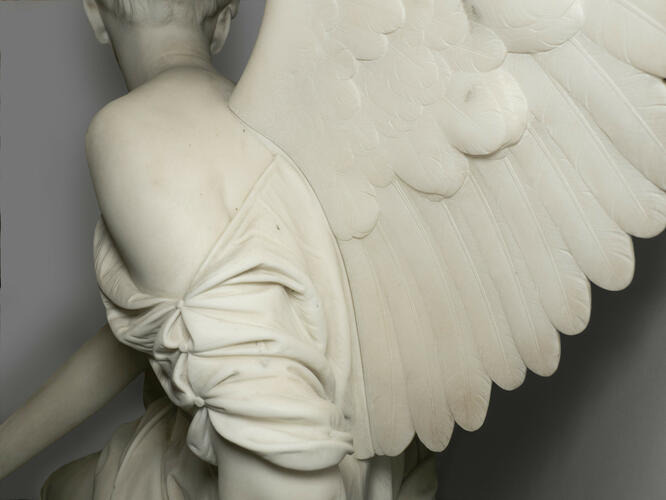
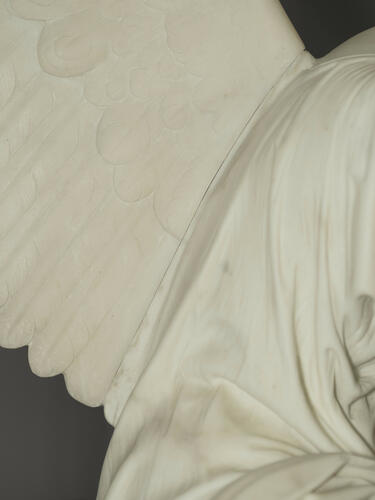
A white marble life-size winged female figure of Victory, clad in fluid, antique drapery, seated on a stylised rocky platform, her right foot resting on an upper step and the left foot hanging below. Her wings, which were carved separately and tenoned to the shoulders (the joints pointed in fine mortar) are held upright. Their upper surfaces are not carved. Her head, with hair tied up at the back, is turned to the right and she stoops slightly forwards. Her right arm is drawn across the body and in her right hand she holds a garland composed of oak foliage and acorns, as if preparing to hurl it to the right. Her left arm hangs down by her side. The statue rests on a squared block of white marble. The surface overall is exceptionally smooth, with almost no trace of tool marks. The first four toes of the left foot, and the lower-left corner of the rockwork, have been detached and re-attached. On the back is a card label with the number: 340.1.
Between 1832 and 1842 Christian Daniel Rauch and the members of his large Berlin workshop were employed to provide sculptures for the Walhalla, a colossal peripteral Doric temple designed by Leo von Klenze for Ludwig I of Bavaria. Placed in a commanding position on the Danube near Regensburg, it was designed to contain the likenesses in marble of the greatest figures in German history. Rauch was responsible for six life-size winged Victories which punctuate the arrangements of busts on ledges and brackets against the walls of the single interior space. This is one of four marble replicas of the fourth of the Victories.
Rauch’s six statues, which do not follow ancient forms, seem to have been designed and modelled one by one. This figure, the fourth, known as the Kranzwerfenden Viktoria (garland hurling Victory), became the best known of the six, as the sculptor himself seems to have predicted in a letter to his pupil Ernst Rietschel in 1834, when he wrote that this model was ‘the most pleasing and significant’ of the series so far. The figure was originally conceived to hold a second garland in her left hand. The first marble was completed in 1841.
This replica was commissioned by Frederick William IV, King of Prussia, as a gift for Queen Victoria, but never ultimately presented to her by him. Frederick William deployed the pun of Victory/Victoria on a number of occasions, and when he visited England to stand as godfather to Albert Edward, Prince of Wales, at Windsor on 25 January 1842, he presented Queen Victoria with two other marble statues by Rauch (Faith and Charity).
Casts of all six Victories were included in the Sculpture Courts at the Crystal Palace, Sydenham in 1851. According to the Official Catalogue of the Great Exhibition, this Victory was carved at Carrara from Rauch’s model. Queen Victoria purchased it in July 1851 and presented it to Prince Albert on his birthday, 26 August. At Osborne the statue was installed on the Ground Floor Corridor, which was gradually being stocked with the Queen and Prince Albert’s collection of ideal sculptures.
Text adapted from Sculpture in the Collection of His Majesty The King (2025)Provenance
Commissioned by Frederick William IV, King of Prussia; purchased by Queen Victoria at the Great Exhibition in July 1851 (£370) and presented to Prince Albert on his birthday, 26 August; placed at Osborne, Ground Floor Corridor.
-
Creator(s)
Acquirer(s)
-
Medium and techniques
Marble
Measurements
214.0 x 104.0 x 70.0 cm (whole object)
Category
Object type(s)


