


-
1 of 253523 objects
Ferdinand Olivier (1785-1841)
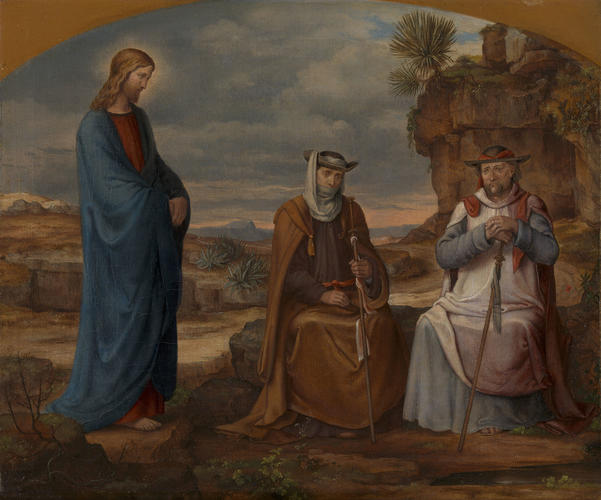
The Journey to Emmaus 1827
Oil on canvas | 25.6 x 30.5 cm (support, canvas/panel/stretcher external) | RCIN 408939
Queen's Sitting Room, Osborne House
Ferdinand Olivier (1785-1841)
The Journey to Emmaus 1827
-
Johann Heinrich Ferdinand Olivier (1785-1841) was born into a noble family from the canton of Vaud, Switzerland. His father, a teacher and philanthropist, would have preferred to keep his son as an associate, and did not permit him to devote himself to art until 1804. During that year he went to Dresden with his elder brother Heinrich, where they became pupils of the landscape artist Jakob-Wilhelm Mechau. In Dresden they came into contact with members of the German Romantic movement, including Caspar David Friedrich. In 1811 Olivier settled in Vienna. There he developed a friendship with Joseph Anton Koch, and joined the group of painters known as the Nazarenes, in 1817. He painted many biblical subjects, and was particularly interested in the representation of landscape as a means of expressing Christian iconography. The background in this painting recalls that deployed in his Abraham and Isaac (1817: National Gallery), in which the artist drew upon his experience of the Salzburg landscape. Also evident here is the consciously archaic style which Olivier shared with his fellow Nazarenes, together with an interest in medieval art, and that of the early German masters.
The story of the Supper at Emmaus comes from the Gospel of St Luke: Cleophas and an unnamed disciple meet a stranger on the road to Emmaus. They persuade him to share a meal with them, and during the supper, as he breaks and blesses the bread, they recognise him as the risen Christ. This is one of a pair of paintings by Olivier in the Royal Collection, treating the story (see RCIN 408938). Usually such a pair show the journey and the supper. These seem to have been part of a set of four; these two both treating the journey; the other two presumably treating the supper. This second scene takes place in a barren rocky landscape; Christ, wearing a red robe and a blue mantle, stands looking down upon the two seated disciples, who appear lost in melancholic contemplation of the recent death of Jesus, whom they do not recognize. The idea of spinning out the uncertainty of the encounter in two scenes, may be to suggest that the modern pilgrim must learn to live with doubt.Provenance
Probably from a set of four works by Olivier, depicting Christ at Emmaus, presumed lost for some time. All four were bought by Frederick William of Prussia, in 1827. This is one of the pair given to Queen Victoria by her daughter the Empress Frederick, wife of Frederick William, 10 February 1895.
-
Creator(s)
Acquirer(s)
-
Medium and techniques
Oil on canvas
Measurements
25.6 x 30.5 cm (support, canvas/panel/stretcher external)
40.4 x 46.5 x 5.5 cm (frame, external)
Alternative title(s)
The journey to Emmaus: "But their eyes were holden"


