


-
1 of 253523 objects
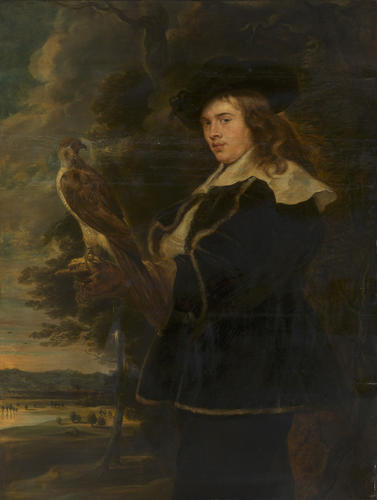
A Young Man with a Falcon c.1630
Oil on panel | 140.0 x 105.7 x 2.5 cm (support, canvas/panel/stretcher external) | RCIN 407527
Attributed to Jan van Boeckhorst (Münster 1605-Antwerp 1668)
A Young Man with a Falcon c.1630
-
A man shown at three‑quarter length is standing within a landscape and holding a falcon on his gloved left hand. In the seventeenth‑century Netherlands, falcons were symbols of wealth and power, reserved for the highest ranks of the nobility, and only a privileged few would have been permitted to handle – and be portrayed with – an animal of such prestige.
The man’s clothing further illustrates his high social status. The feather‑trimmed hat and a broad collar – which has been dated to the 1630s – is draped over a fur‑lined jacket with open, slit sleeves, beneath which a dark-coloured doublet with matching slashed sleeves reveals the white shirt underneath. There is a striking contrast between the highly detailed rendering of the facial features and the more loose and quick handling of paint in the background, especially in the tree on the right.
For George IV this fascinating portrait of a man was an important work by Rubens: he hung it in the South Ante-Room at Carlton House and valued it at 500 guineas. The painting is also shown in the upper right of Adriaen de Lelie’s depiction of the famous art collection of Jan Gildemeester Jansz (Rijksmuseum, SK-A-4100).
Despite having been admired as a painting by Rubens throughout the nineteenth century, neither the rendering of the figure nor the landscape convincingly support this attribution. The recently suggested name of Boeckhorst has not been universally accepted, but there is strong visual evidence that the artist is either a pupil or someone in the circle of Rubens.Provenance
Probably Duc de Choiseul-Praslin sale, Paris, 18 Feb 1793 (28); Gildemeester collection; sale Amsterdam, 11-13 June 1800 (188); Purchased as a Rubens by George IV from Sir Thomas Baring as part of a group of 86 Dutch and Flemish paintings, most of which were collected by Sir Thomas’s father, Sir Francis Baring; they arrived at Carlton House on 6 May 1814; recorded in the South Ante-Room at Carlton House in 1819 (no 46), where it appears in Pyne's illustrated Royal Residences of 1819 (RCIN 922182); in the Picture Gallery at Buckingham Palace in 1841 (no 140)
-
Creator(s)
Previously attributed to (artist)Previously attributed to (artist)Acquirer(s)
-
Medium and techniques
Oil on panel
Measurements
140.0 x 105.7 x 2.5 cm (support, canvas/panel/stretcher external)
106.4 cm (maximum)
Category
Object type(s)
Other number(s)
Alternative title(s)
The Falconer


