


-
1 of 253523 objects
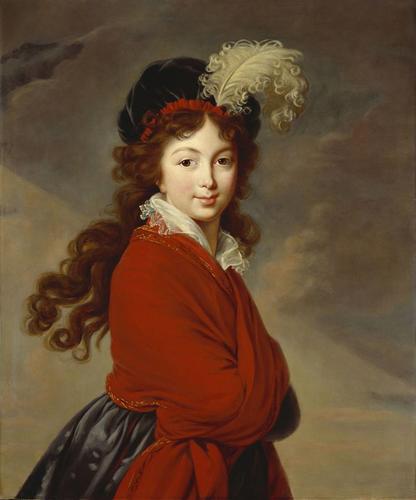
Juliane, Princess of Saxe-Coburg-Gotha (1781-1860) 1844
Oil on canvas | 83.8 x 70.8 cm (support, canvas/panel/stretcher external) | RCIN 407174
William Corden the Younger (1819-1900)
Juliane, Princess of Saxe-Coburg-Gotha (1781-1860) 1844
-
This work is after a portrait of 1797 of Juliane, later Grand Duchess Anna Feodorovna, by Vigée Le Brun (Pushkin State Museum of Fine Arts, Moscow). Le Brun recorded that she painted two half-length portraits of the Princess during her sojourn in St Petersburg, and one of these was recorded in the Herzogliches Museum, Gotha before the Second World War.
The original portrait dates from around the time of the sitter’s marriage to Grand Duke Constantine, brother to Alexander I and Nicholas I. However, her marriage was not a success; by 1813 she had settled in Switzerland, and the couple were divorced in 1820. The sitter was described by Vigée Le Brun in her Memoirs as ‘not as outstandingly beautiful as her sister-in-law, but still very pretty. She must have been about sixteen and the most lively exuberance shone through her features’. In 1844, William Corden accompanied his father, William Corden the Elder, to Coburg, in order to copy a number of family portraits. The visit was arranged by Prince Albert. In addition to this engaging portrait of Juliane, aunt to both Queen Victoria and Prince Albert, he painted her sisters, Antoinette (1779–1824) and Sophie (1778–1835), and their mother, Augusta, Duchess of Saxe-Coburg-Saalfeld (1757–1831), also grandmother to Queen Victoria and Prince Albert (RCINs 406491, 406490,406489). The portraits are recorded hanging in Queen Victoria’s Bedroom at Windsor Castle in the mid-nineteenth century, as part of a set of twelve family portraits, identically framed (see RCIN 919810).
Here, Corden, praised by Queen Victoria and Prince Albert for his skills in copying, captures some of the sitter’s liveliness and youth; however, the arresting pose and striking contrast between her red shawl, white collar and mass of brown locks are thanks to the mastery of Vigée Le Brun’s brush.
William Corden the Younger (1819–1900) studied and worked with his father, William the Elder. On a trip to Coburg in 1844, William the Younger also painted six watercolour views of the town for Prince Albert. In 1850 he was commissioned by Queen Victoria to visit Lisbon, in order to copy the portrait of Ferdinand, king consort of Portugal, by Ferdinand Krumholz. Instead, he actually painted original full-length portraits of Queen Maria II, and her husband (RCIN 403690, 403691, 406254, 400959). Queen Victoria regularly employed him to copy portraits in her collection, usually as presents, including about fifty by Franz Xaver Winterhalter (1805-73). Between 1843 and 1855, he exhibited eight works at the Royal Academy.
A further anonymous copy is in the Royal Collection (RCIN 402496).
Text adapted from Russia: Art, Royalty & the Romanovs, London, 2018Provenance
Painted for Queen Victoria in 1844; recorded hanging in the Queen's Bedroom at Windsor Castle in 1878
-
Creator(s)
Acquirer(s)
-
Medium and techniques
Oil on canvas
Measurements
83.8 x 70.8 cm (support, canvas/panel/stretcher external)
108.4 x 94.7 x 6.2 cm (frame, external)
Category
Object type(s)
Alternative title(s)
Juliana, Princess of Saxe-Coburg-Gotha (1781-1860), later Grand Duchess Anna of Russia
Princess Juliana Henrietta Ulrica, 7th daughter of Frederick, Duke of Saxe-Coburg-Saalfeld, afterwards Grand Duchess Constantine of Russia, previously entitled
Juliane, Princess of Saxe-Coburg-Saalfeld, Grand Duchess Anna Feodorovna (1781–1860)


