

-
1 of 253523 objects
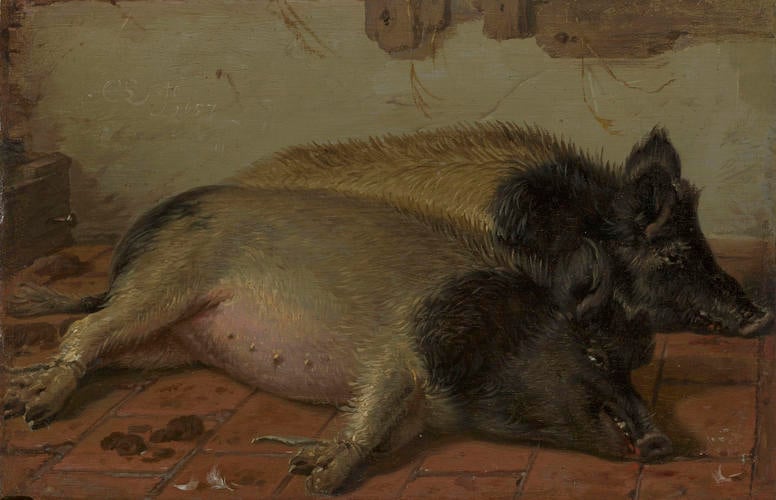
Two Pigs Signed and dated 1657
Oil on panel | 15.6 x 23.4 cm (support, canvas/panel/stretcher external) | RCIN 406509
Cornelius Saftleven (Gorinchem 1607-Rotterdam 1681)
Two Pigs Signed and dated 1657
-
This painting has been described as ‘pigs’ since the time of George IV; it should perhaps be called ‘the carcasses of two pigs’. The animals are bound and lie without apparent struggle, while a tiny trickle of blood issues from their mouths. The scene is not bloodier still because they would already have been bled carefully into a vessel to make black pudding. They presumably await hanging and cutting into joints.
These processes are illustrated in many seventeenth-century Netherlandish landscapes depicting the season of Winter or the months of November and December. Pig-slaughtering was a prelude to the festive season and the main or only source of meat for most country families at this time.
There are other examples of beautifully realised depictions of the domestic matter-of-fact in Holland at this time, including Rembrandt’s ‘Slaughtered Ox’ of 1655 (Louvre) and Carel Fabritius’s ‘Goldfinch’ of 1654 (Mauritshuis).
Inscribed to the left: 'C. S. fe / 1657'; the false signature 'P. Potter f.' is also visible.Provenance
Purchased by George IV from Sir Thomas Baring (as by Paulus Potter) as part of a group of 86 Dutch and Flemish paintings, most of which were collected by Sir Thomas’s father, Sir Francis Baring; they arrived at Carlton House on 6 May 1814; recorded in the Bow Room, Ground Floor, at Carlton House in 1819 (no 117) and anti-Room to the Dining Room in 1819 (no 97); in the Picture Gallery at Buckingham Palace in 1841 (no 104)
-
Creator(s)
Previously attributed to (artist)Acquirer(s)
-
Medium and techniques
Oil on panel
Measurements
15.6 x 23.4 cm (support, canvas/panel/stretcher external)
24.3 x 31.9 x 4.0 cm (frame, external)
Other number(s)


