


-
1 of 253523 objects
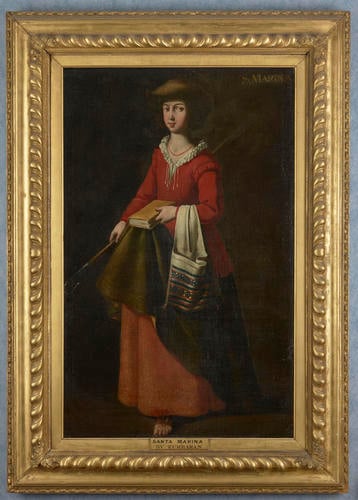
St. Margaret of Antioch 1650-1700?
Oil on canvas | 91.4 x 58.1 cm (support, canvas/panel/stretcher external) | RCIN 404426
Attributed to the studio of Francisco Zurbaran (1598-1662)
Frame for RCIN 404426, after Zurbaran, St. Margaret 1650-1700?
Attributed to the studio of Francisco Zurbaran (1598-1662)
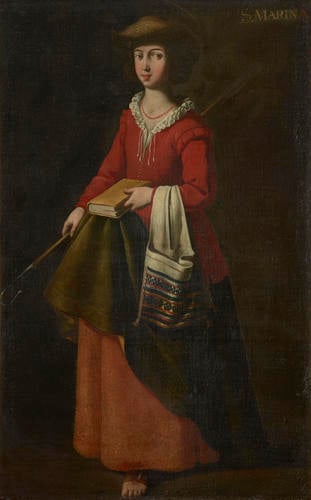
St. Margaret of Antioch 1650-1700?
-
Francisco de Zurbarán was one of the great masters of the school of Seville and is renowned for his powerful and realistic interpretation of monastic life in 17th-century Spain.
Zurbarán’s paintings of single saints can be seen as a continuation of those that were painted in Seville in early seventeenth century, beginning with those of Francisco Pacheco (1564-1644) and continuing with the work of Francisco Varela (c.1580-1645) and Juan del Castillo (1590-1640). The majority of Zurbarán’s paintings of saints were commissioned as series and executed largely by assistants. In 1647, the artist received an order for twenty-four paintings of Virgin Saints for a monastery in Lima and two years later, was commissioned to paint a further group of fifteen for Buenos Aires. However, Zurbarán’s original painting of St Margaret (National Gallery, London), of which this painting in the Royal Collection is a studio copy, appears to have been a rare autograph work executed as a single painting rather than as part of a series. It may plausibly be identified as a portrait a lo divino, meaning 'in a sacred manner'. Such portraits, in which the sitter was depicted with the iconography of the saint whose name they shared, were fashionable in Spain in the first half of the seventeenth century, tapping into the prevailing religious fervour of the period.
St Margaret, sometimes known as Saint Marina was martyred in Antioch at the beginning of the fourth century. Legend has it that she defeated a dragon and traditional depictions show her with such a creature. This picture is a simplified version of Zurbarán’s painting of Saint Margaret, dating from the early- to mid-1630s. It shows the virgin saint in the picturesque costume of a shepherdess with a crook and alforjas (saddlebags), in reference to her role in grazing the sheep of her nurse. The book and the cross around her neck are the only explicitly religious features of the painting.
Zurbarán’s St Margaret was extensively copied, not least by his own studio. Other whole-length examples survive in the Konstmuseum, Gothenburg and the Barber Institute, Birmingham, while the Museo Carmen Thyssen in Málaga holds possibly autograph three-quarter length variant. The National Gallery painting, then in the Spanish Royal Collection in Madrid, was engraved in 1794 by Bartolomé Vázquez, with examples held by the Biblioteca Nacional, Madrid, Bibliothèque Nationale in Paris and the British Museum.Provenance
Purchased by Queen Victoria from Sir H. L. Bulwer for £21, June 1854; previously purchased by Durlacher, from the sale of King Louis Philippe, Messrs. Christie & Manson, May 6-21, 1853, Lot 390.
-
Creator(s)
Acquirer(s)
-
Medium and techniques
Oil on canvas
Measurements
91.4 x 58.1 cm (support, canvas/panel/stretcher external)
Alternative title(s)
Santa Marina


