


-
1 of 253523 objects
Classical Ruins in a Landscape 1630-40
Oil on canvas | 92.3 x 105.5 x 2 cm (support, canvas/panel/stretcher external) | RCIN 404008
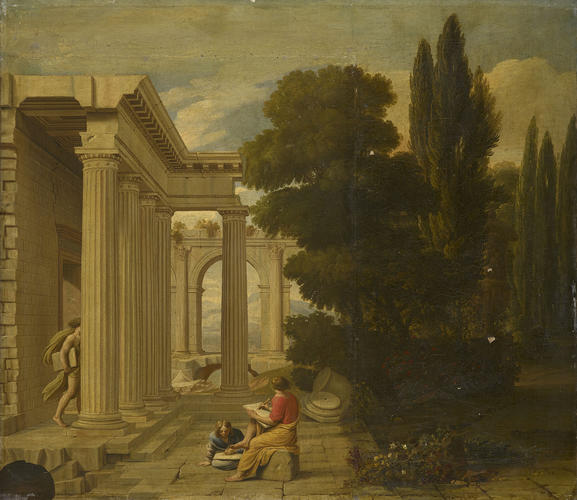
Jean Lemaire (1598-1659)
Classical Ruins in a Landscape 1630-40
-
Jean Lemaire was a French painter who worked in Rome from an early age, where he became part of the circle of Nicolas Poussin. He sometimes collaborated with Poussin, providing the architectural perspective, especially when the two worked on the Grande Galerie of the Louvre in 1640. Theseus finding his father’s Sword, c. 1636 (Musée Condé, Chantilly) is believed to be a similar collaboration – the figures by Poussin and the architecture by Lemaire.
This painting was originally listed without attribution in the Royal Collection, until 1816 when it was given to Danckerts (the journeyman supplier of Classical landscapes to the English). The more recent attribution to Lemaire (with a date of the early 1630s) has been widely accepted. The painting has been extended; originally it was architecture only (the joins running across just above and down just to the right of the architecture are visible to the naked eye). The attribution to Lemaire belongs to the left hand side; the right hand trees were probably added around 1700 by a local artist when the painting was already in the Royal Collection, in order that it might fit an overdoor position. The original part of the composition exhibits a superb clarity of classical architecture, semi-ruined in order to show the structure of its walls and foundations, almost like a cut-away drawing. The figures have Poussin’s studious antique air - two are drawing and the third holds a porte folio under his arm. They are deliberately not presented to the viewer as in a play – one looks down, one turns away and the third is obscured by a column.Provenance
Probably the 'Landscape and building, with two figures in it' recorded in the King's Dining Room below stairs at Windsor Castle in 1688; in the nearby Side Board Room below stairs in 1710 as 'landscape with building & figures one drawing after it.' It remained in this position throught the eighteenth century, described in 1750 as an 'overdoor'. It is still in Windsor in 1816 with an attribution to Danckerts and measurements matching the current size.
-
Creator(s)
-
Medium and techniques
Oil on canvas
Measurements
92.3 x 105.5 x 2 cm (support, canvas/panel/stretcher external)
80.0 x 64.9 cm (support (etc), excluding additions)
107.3 x 120.5 x 5.5 cm (frame, external)
Category
Object type(s)
Alternative title(s)
Ruins in a landscape
Artists sketching among ruins


