


-
1 of 253523 objects
The Solovetsky Monastery ?c.1600-1650
Oil on panel | 28.1 x 23.0 cm (support, canvas/panel/stretcher external) | RCIN 403387
Attributed to Russian School, 17th century
The Solovetsky Monastery ?c.1600-1650
Attributed to Russian School, 17th century
The Solovetsky Monastery ?c.1600-1650
-
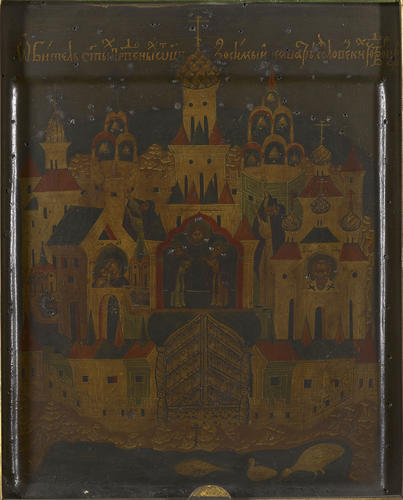
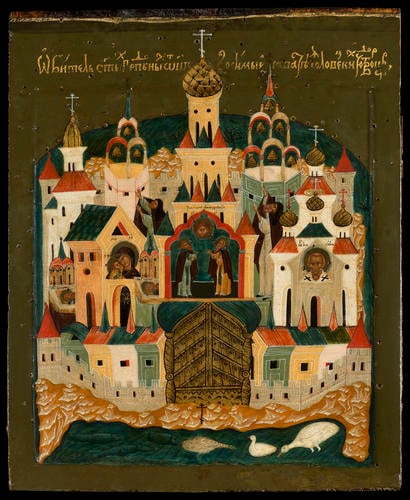
This icon depicts the monastery founded by St Savvaty and St Zosima, monks of the so-called ‘Northern Thebaid’ (the tradition in Russiaof monks living in the wilderness, as the early Christian monks and hermits had lived near Thebes in Egypt). Founded in 1436 on Solovetsky Island in the White Sea, it was a centre of spirituality and grew to be a major centre of prayer, icon painting and pilgrimage. It was also a centre of Old Believer activity, following the schism of the late seventeenth century after the alterations to the liturgy and church practices under Patriarch Nikon (1605–81). More than 20 of these icons are known; as a rule, they are of relatively small size and almost square in format. Depending on the date of painting, the monastery walls are constructed either of wood (an earlier version, built c.1578) or of stone.
The icon shows, in the centre, the two founding saints to right and left of an image of the Redeemer (made without hands), as if inside the centre of the Transfiguration (Preobrazhensky) Cathedral (1556–64), with the Dormition (Uspensky) Cathedral (1552–7) to the left with its icon of the Virgin, and the Nicholas (Nikolsky) Cathedral, with its icon of St Nicholas, to the right, all carefully detailed. To the left of the Dormition Cathedral, with the icon of the Virgin, is a shrine of St Zosima, showing the saint’s relics in repose, and the shrine of St Savvaty next to the Transfiguration Cathedral. The presence of the icons and view of the saints’ relics – giving the impression of a tour of the monastery’s treasures, as well as its size – points to the icon as one for personal devotion, most likely for one of the monks of the monastery.
The geographical and physical isolation of the monastery is illustrated by its high walls with seven gates and eight towers (built in 1584–94 by an architect named Trifon) leading onto the White Sea. The riches of the sea around the monastery, with fish, ducks and geese in the waters, allude to the natural resources (along with salt, pearls, mica and wood) which supported the monastic community and a significant lay population. In a similar icon in the collection of Girton College, Cambridge, whales and porpoises can be seen. While desolate and difficult to reach, the environs of the monastery and the island are clearly delineated by the icon painter; for example, the details of trees and foliage, and the island quality of the location is emphasised by the sweep of water around the monastery. The details of the buildings, and in particular the sense of activity and allusion to the sounds of monastery life, seen with the two bell-ringers pulling ropes, give animation to the image. The central cathedral of the monastery dedicated to the Transfiguration is presented as an image of Christ flanked by the two founding saints, rather than following the description of the events in the Gospel, where the prophets Elijah and Moses flanked the transfigured Christ, possibly suggesting that the founders of the monastery were echoing the patriarchs of the Old Testament. This can be compared with an icon in the Museum of Russian Icons, Moscow, showing the Transfiguration icon flanked by the two saints who were canonised in 1547.
A particular feature of this icon is a thoroughly painted underdrawing layer in black paint, visible through the paint layers, particularly in the architecture. Following its painting, the icon was covered with basma, sheets of embossed or engraved metal, which were pinned to the surface, surrounding and enhancing the key features of the painting, but obscuring other areas. At some point, this has been removed, but the holes, and in some cases the tacks, survive. The icon bears the label inscribed II Zimmer, on the reverse, which could refer to a hanging arrangement in the Oettingen-Wallerstein collection.
Text adapted from Russia: Art, Royalty & the Romanovs, London, 2018Provenance
One of the group of Russian icons from the 77 paintings belonging to Prince Ludwig von Oettingen-Wallerstein (1791-1870), which were first offered to Prince Albert in 1847 as security for a loan and came into his possession by default (no 9 in Waagen’s catalogue of 1854); 25 of them were accepted by the National Gallery in 1863.
-
Creator(s)
Acquirer(s)
-
Medium and techniques
Oil on panel
Measurements
28.1 x 23.0 cm (support, canvas/panel/stretcher external)
45.5 x 28.9 cm (frame, external)
Category
Object type(s)
Subject(s)
Alternative title(s)
View of the Solovetsky Monastery on the White Sea
Icon of St Zosima and St Savvaty with the Monastery of Solovetsky


