


-
1 of 253523 objects
Vase à monter c.1782-86
Hard paste porcelain, dark blue ground and gilt bronze | 37.0 x 24.0 x 15.5 cm (with fittings) | RCIN 36107
Sèvres porcelain factory
Master: Vase a monter c.1782-86
-
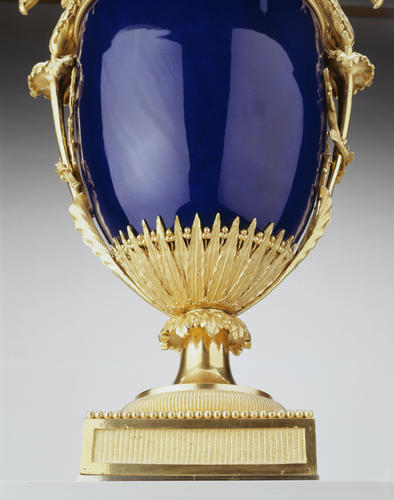
These egg-shaped vases, which have angled shoulders and a short circular neck sit in gilt bronze cups formed by a band of laurel leaves alternating with clusters of three berries on slender stems, and overlain by a further band of upright laurel leaves. The plain burnished stem terminates at the top in a flounce of acanthus leaves and berries and at the bottom in a rounded moulding which is matt-surfaced and vertically striated. Overlying the leaf cups, at each end, are double rods entwined with laurel leaves and partly sheathed in palm leaves; the rods terminate in arched eagle-head handles issuing out of foliate sheaths above an acanthus-leaf flounce. Four scrolled vine trails, springing from the foliate sheaths of the handles, rest on the shoulders of the vase, which is mounted with a beaded moulding chased with a coiled-rope motif. The top ring, which is chased with a gadrooned and stylised husk moulding, terminates in a delicate coiled-rope motif. Each vase is fitted with a gilt bronze liner extending the depth of the neck.
They stand on square gilt bronze plinths which are beaded on the rebated upper edge and decorated with vertically striated matt panels on all four sides. The stem and foot, which are separate from the body, are secured by a porcelain stump that engages in a hole pierced in the bottom of the vase.
Both the mounts and the vases, whether made of Sèvres porcelain or of marble, were almost certainly commissioned, and probably also designed, by the marchand mercier (dealer/designer) Dominique Daguerre. If it is correct to assume that the mounts were made to the order of the Director of Sèvres, the probability is that they were supplied by the manufactory’s accredited bronze manufacturers, either Jean-Claude-Thomas Duplessis fils (d. 1783), or his successor Pierre-Philippe Thomire. Some of the mounts are, however, English replacements, as can be confirmed by a bill of Henry J. Hatfield, dated 12 October 1903. The entry reads: ‘Grand Corridor [Windsor Castle] Pair Blue Sevre China Vases with double eagle head handles, make, fit & gild 8 Vine leaf & scrole pieces for above handles, & 5 laurel sprigs running up stems of same, solder & gild the handles & generally repair & restore remainder of mounts & secure plates on bottom for fixing £15’.
Text adapted from French Porcelain: In the Collection of Her Majesty The Queen, London, 2009Provenance
Probably acquired by George IV through his intermediary, Dominique Daguerre, the marchand-mercier (dealer-decorator), in the late 1780s.
Pierre-Philippe Thomire was the outstanding Parisian bronzeur and gilder of the early nineteenth century. He supplied finely chased mounts to leading Parisien ébénistes for furniture, clocks and the Sèvres porcelain factory. He was much patronised by Napoleon who made him Ciseleur de l'Empereur. His work represents some of the finest examples of Empire style.
In 1804 he acquired business of the marchand-mercier, Martin-Eloi Lignereux. The company employed a large workforce in a workshop at rue Boucherat and a showroom at rue Taitbout, from where Thomire retailed a large range of decorative objects inspired by antiquity including candelabra, extravagant centrepieces, clock cases and monumental Greek and Roman style urns and vases.
Thomire collaborated with three partners, renaming the business for a time Thomire, Duterme et Cie. The business suffered as a result of France's continuing European hostilities and to avoid bankruptcy the firm was granted dispensation to trade with the Prince Regent . Soon after 1815 the partnership with Duterme was dissolved and, under the old style, Thomire et Cie thrived once more under the restored Bourbons.
Thomire retired in 1823 and his two sons-in-law, Louis-Auguste-Cesar Carbonelle and André-Antoine Beauvisage, continued the business until 1852. Thomire continued to work as a sculptor and exhibited regularly at the Salon until 1834.
-
Creator(s)
(porcelain manufacturer)(metalworker)(nationality)Acquirer(s)
-
Medium and techniques
Hard paste porcelain, dark blue ground and gilt bronze
Measurements
37.0 x 24.0 x 15.5 cm (with fittings)
37.1 x 23.5 x 15.5 cm (with fittings)
Category
Object type(s)
Other number(s)
Laking PC : Laking, G.F., 1907. Sèvres Porcelain of Buckingham Palace and Windsor Castle, London – Laking PC 303Alternative title(s)
Pair of vases
Place of Production
Sèvres [France]


