


-
1 of 253523 objects
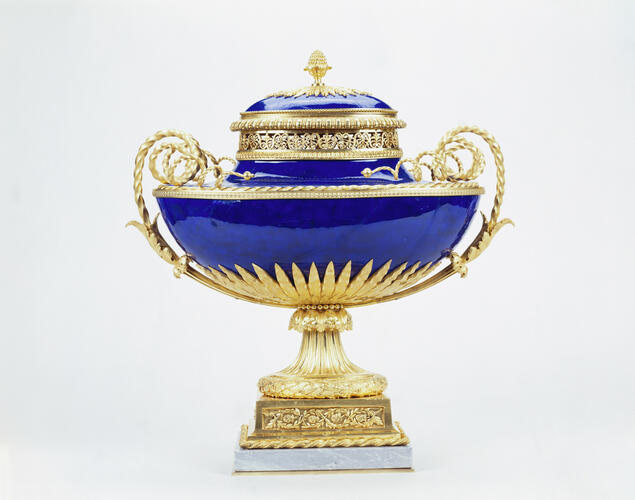
Vase Daguerre ovale c. 1785-86
Hard-paste porcelain, dark blue ground, gilt bronze and marble | 40.0 x 37.7 x 19.1 cm (with fittings) | RCIN 35515
-
This pair of vases are fitted with richly chased gilt bronze mounts, which include a pierced band, corkscrew handles, a stem, foot and base. The plinths are of grey marble. Oval-shaped with stepped shoulders, a short incurving neck and an oval domed cover they rest in gilt bronze cups of radiating laurel leaves in two layers above a splayed stem, which is chased with pendent flutes alternating with flattened gadroons. The stems terminate at the top in a flounce of acanthus foliage and berries and at the bottom in circular feet chased with berried laurel wreaths. They stand on a square bases splaying out slightly towards the bottom and mounted in recessed panels on all four sides with crossed myrtle trails enclosing roses. Mouldings in the form of a twisted ribbon edged with beading runs round the bottom edge of the bases.
The ribbed handles, which emerge from the stems, are sheathed in acanthus foliage in the middle sections and are of corkscrew design at the top, where they each split into two coils diminishing in scale. Running round the shoulders is a twisted rod accompanied by an outer band chased with stylised pendent water-leaves. Separating the cover from the vase is a pierced band of anthemions, flanked above by a rim composed of alternating gadroons and beading, and below by a flat moulding chased with water-leaves. The covers are edged with beading on the rims and are crowned by a knob formed by a foliate seed pod springing from a radiating base of alternating laurel leaves and stylised foliage.
The vase was designed to be fitted with mounts. There is every likelihood that the marchand mercier (dealer/decorator) Dominique Daguerre was responsible for commissioning vases of this model, both round and oval, which he would then have had fitted with mounts. It may well have been on versions of this model, variously described as ‘Vases Bassinoire pour M. D’aguerre’, ‘Vases bassinoire’ and ‘vases de M. Daguerre’, that the repareur Louis Petion père was working from May to December 1785. The mounts can be attributed to Pierre-Philippe Thomire, who since August 1783 was the manufactory’s accredited bronze supplier. In Daguerre’s inventory drawn up on 15 frimaire an V (5 December 1796) following his death, a pair of oval Sèvres vases with mounts were recorded which could well have corresponded to this vase and its pair. The entry reads: ‘Item deux vases d’ornement en porcelaine de Svères gros bleu forme allongée avec pieds, culots anses et gorges à cuivre doréor moulu 300 francs’.
Text adapted from French Porcelain: In the Collection of Her Majesty The Queen, London, 2009Provenance
On the evidence of the label marked 33, .1 can be identified in the 1826 porcelain inventory of Carlton House in the South Anti Room, Principal Floor: ‘No 33. An Oval shaped blue Seve Porcelain Vase and Cover similar to the last proceeding [sic], but having an ormolu base, on a Dove marble plinth – 15 ½ In. high’. .2 may also have been in the same room, numbered 32 in the inventory, but with a base and plinth differing from their present ones. The entry reads: ‘No 32. An Oval shaped blue seve Porcelain Vase and Cover, mounted in ormolu with scroll handles and pierced rims, ormolu stem, wreathed and leafed, on red mottled marble plinth and pedestal, with embossed pannel ornaments – 19 In. high’. As there is no other vase in the Royal Collection of the same shape as .1, which is fitted to a red griotte marble plinth and pedestal, the assumption is that at some later stage No.32 in the inventory was made to match No.33. A close comparison of the mounts on their bases reveals some telling differences. The chasing of the twisted ribbon and the panels of crossed myrtle branches enclosing roses are markedly coarser on .1 compared to those on .2. The explanation must be that the replacement marble and accompanying gilt bronze base of RCIN 35515.2 were exchanged in error at some stage after 1826 for the original marble and gilt bronze base of RCIN 35515.1.
Pierre-Philippe Thomire was the outstanding Parisian bronzeur and gilder of the early nineteenth century. He supplied finely chased mounts to leading Parisien ébénistes for furniture, clocks and the Sèvres porcelain factory. He was much patronised by Napoleon who made him Ciseleur de l'Empereur. His work represents some of the finest examples of Empire style.
In 1804 he acquired business of the marchand-mercier, Martin-Eloi Lignereux. The company employed a large workforce in a workshop at rue Boucherat and a showroom at rue Taitbout, from where Thomire retailed a large range of decorative objects inspired by antiquity including candelabra, extravagant centrepieces, clock cases and monumental Greek and Roman style urns and vases.
Thomire collaborated with three partners, renaming the business for a time Thomire, Duterme et Cie. The business suffered as a result of France's continuing European hostilities and to avoid bankruptcy the firm was granted dispensation to trade with the Prince Regent . Soon after 1815 the partnership with Duterme was dissolved and, under the old style, Thomire et Cie thrived once more under the restored Bourbons.
Thomire retired in 1823 and his two sons-in-law, Louis-Auguste-Cesar Carbonelle and André-Antoine Beauvisage, continued the business until 1852. Thomire continued to work as a sculptor and exhibited regularly at the Salon until 1834.
-
Creator(s)
(porcelain manufacturer)(nationality)Acquirer(s)
-
Medium and techniques
Hard-paste porcelain, dark blue ground, gilt bronze and marble
Measurements
40.0 x 37.7 x 19.1 cm (with fittings)
40.0 x 39.3 x 19.0 cm (with fittings)
Category
Object type(s)
Other number(s)
Laking PC : Laking, G.F., 1907. Sèvres Porcelain of Buckingham Palace and Windsor Castle, London – Laking PC 249Alternative title(s)
Pair of mounted pot-pourri vases and covers
Place of Production
Sèvres [France]


