


-
1 of 253523 objects
François Girardon (1628-1715)
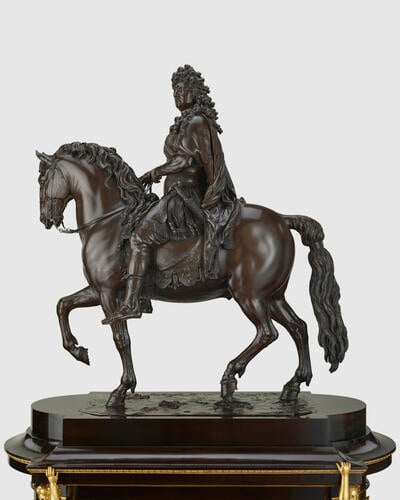
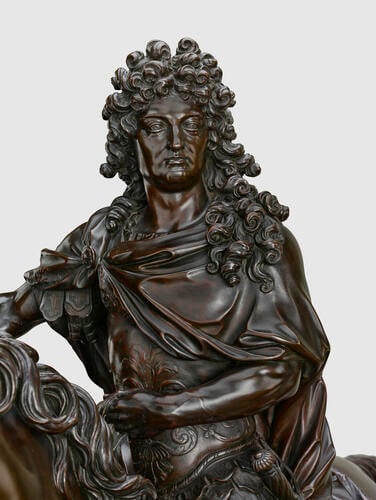
Louis XIV of France (1638-1715) c. 1696
Bronze | 105.5 x 92.0 x 50.0 cm (whole object) | RCIN 31359
Green Drawing Room, Windsor Castle
-
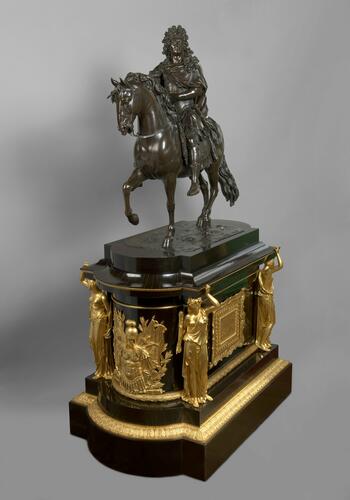
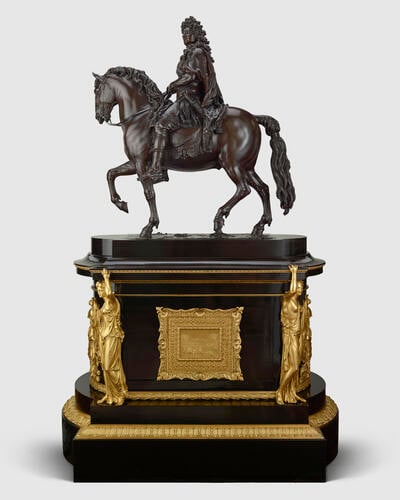
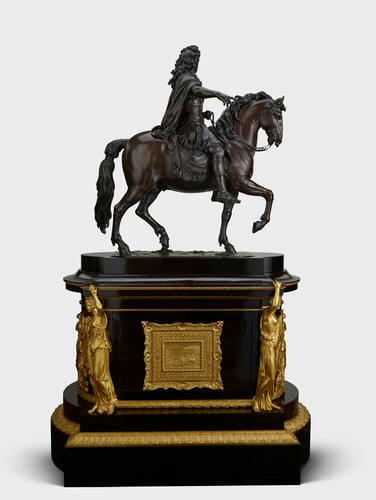
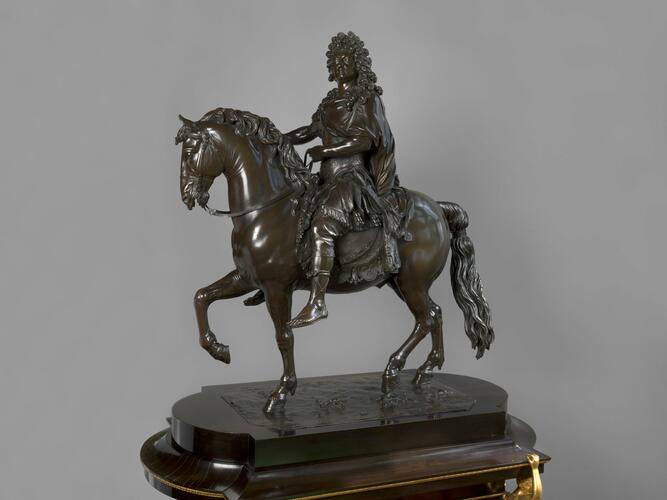
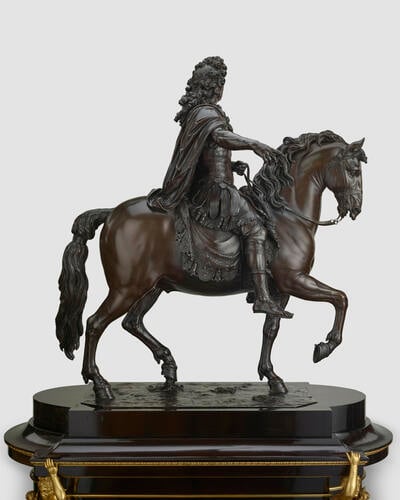
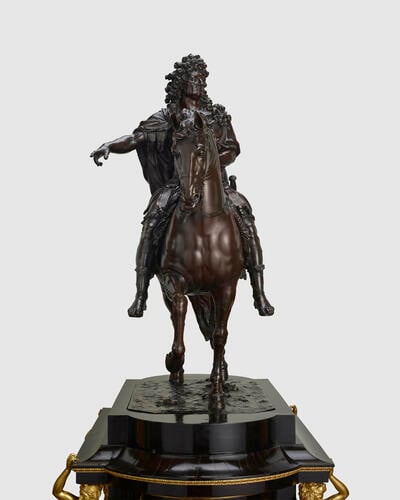
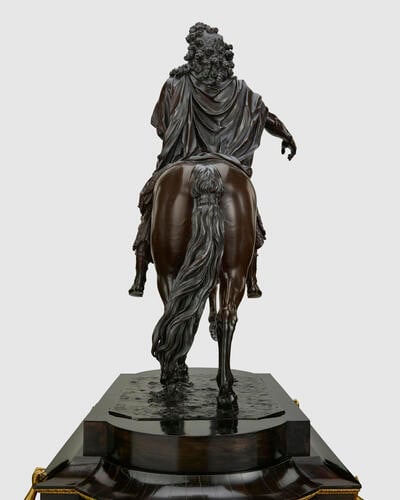
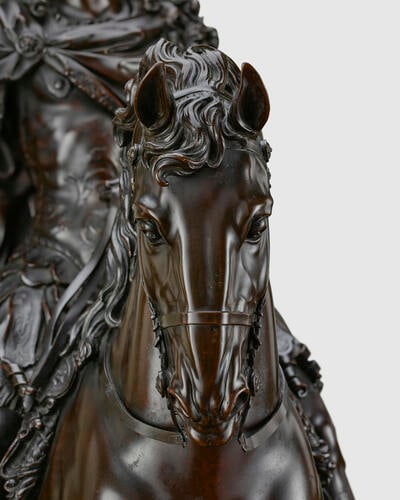
An equestrian bronze statue of Louis XIV in Roman armour, on a rectangular naturalistic base with canted corners. The statue is mounted on an ebony-veneered pedestal with gilt bronze mounts ordered from the firm of Thomire et Cie. in 1826. The sides of the pedestal are set with framed reliefs after compositions by Adam Frans van der Meulen (1632-1690) of Louis XIV Crossing the Rhine (11 June 1672), and the Capture of Valenciennes, (16 March 1677). Martial trophies are applied to the ends of the pedestal, and at the four corners are figures of Virtues.
This is a cast from the small-scale model prepared by Francois Girardon for the colossal statue which was cast in a single pour by Balthasar Keller in 1692 and installed in the Place Louis-le-Grand (Place Vendôme) in Paris in 1699. The statue was destroyed in 1792.
It is thought that four bronzes of the present size (that of the sculptor’s small model) were made during Girardon’s lifetime. One was ordered by the king himself, moulded from Girardon’s small model by Drouart and cast by Le Pileur in 1696, for which Girardon designed an elaborate carved, marbled and gilded wooden pedestal, unrelated to that of the Place Vendôme statue, which was made by Sébastien Slodtz. This bronze was presented by the king to Louis II Phélypeaux, comte de Pontchartrain (1643–1727), who served as Chancelier de France from 1699 to 1714. Pontchartrain was involved in the creation of the Place Vendôme statue.
Several examples of the small version are known, some of which were cast at the time of the project and others later. This example is thought to have been cast by Jean Le Pileur in around 1696 and given by the King to the marquis de Phelypeaux, Chancelier de Pontchartrain (1643-1727). The crowned ‘C’ control marks on this statuette demonstrate that it was sold, or at least held as part of a dealer’s stock, between 1745 and 1749. The only public sale to have included a bronze of this description between these dates was that held in Paris in 1747 after the death of Jérôme, comte de Pontchartrain. The bronze was acquired by the Fermier Général de la Haye. It was re-sold from the collection of his widow in 1778, and again in 1784 by the collector Légère.
The bronze was photographed by X-radiography at the J. Paul Getty Museum in Los Angeles in 2009. The presence of a network of substantial armatures within the body of the horse and down each leg confirm it to have been a direct cast, with the founder’s model remaining within the bronze.
The replacement of the pedestal on which the bust was originally acquired was no doubt prompted by the decision to give the bronze a place of honour in George IV’s new apartments at Windsor Castle. The new pedestal was commissioned by François Benois (who had bought the bronze for his employer in 1817) from Thomire et Cie. The four figures of Virtues may have been inspired by the figures representing Justice, Fortitude, Prudence and Peace which stood at the corners of the base of Bouchardon’s statue of Louis XV in what is today the Place de la Concorde. The gilt-bronze reliefs mounted on either side of the plinth reproduce scenes of Louis XIV’s military triumphs: The Crossing of the Rhine, 11 June 1672 and The Capture of Valenciennes, 16 March 1677 after designs by Adam-Frans Van der Meulen engraved by Charles Simonneau and Robert Bonnart.
When the bronze was being prepared for installation in the splendidly incongruous Gothic revival setting of the State Dining Room at Windsor, the bronze was partially re-patinated by George IV’s interior decorator Nicolas Morel.
Text adapted from Sculpture in the Collection of His Majesty The King (2025) and the exhibition catalogue, Cast in Bronze: French sculpture from Renaissance to Revolution (Paris, New York and Los Angeles, 2008-9), no. 91BProvenance
Ordered by the Bâtiments du roi in 1696 from the founder Jean Le Pileur (d. 1701) and presented by Louis XIV to Louis II Phélypeaux (1643–1727), comte de Pontchartrain; his son Jérome, comte de Pontchartrain; his posthumous sale, 1747; purchased for George IV when Prince Regent in Paris in 1817 by François Benois for £360; placed in the Armoury, Third Room, Carlton House; the pedestal delivered in May 1826; sent to Windsor Castle in September 1828; State Dining Room; Green Drawing Room.
-
Creator(s)
(founder (metals))Acquirer(s)
Commissioner(s)
Subject(s)
-
Medium and techniques
Bronze
Measurements
105.5 x 92.0 x 50.0 cm (whole object)
Category
Object type(s)
Other number(s)


