


-
1 of 253523 objects
John Michael Rysbrack (1693-1770)
George II (1683-1760) c.1739
Marble | 69.8 x 55.5 x 32.5 cm (whole object) | RCIN 31322
-
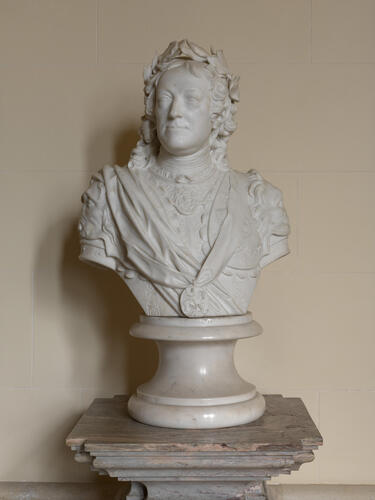
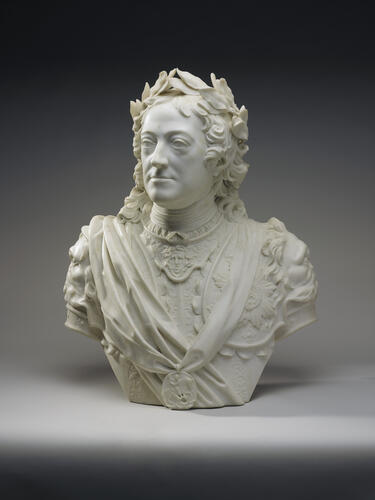
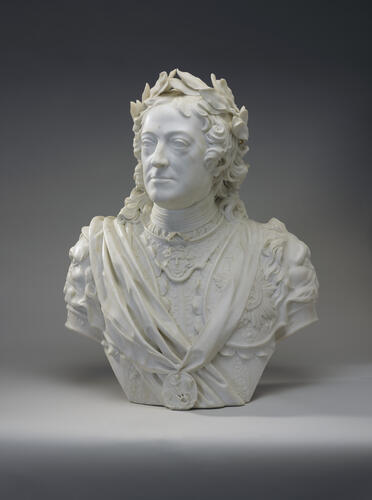
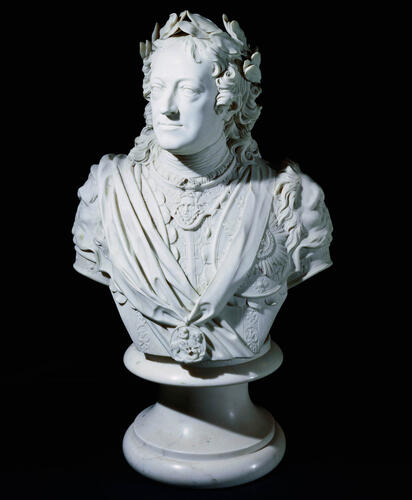
Marble bust of George II, wearing laurel wreath, classical armour with lions' heads on the pauldrons, the George medal, Garter Star and sash. The gorget centered by a medusa head with oval medallion of St George and the dragon.
This is one of a pair of portrait busts made by the Flemish sculptor working in England, John Michael Rysbrack. They were ordered for Queen Caroline, King George II’s consort and were commissioned for the decoration of the new library at St James's Palace, designed by the English architect William Kent. George Vertue, in his diaries, provides valuable information on the origin of these two marble portrait busts. In 1738 he noted that ‘the KING … sat to [Rysbrack] at Kensington twice. to have his picture modelled in Clay. the likeness much approvd on – and with a good Air. – also a Moddel of the Queen vastly like. Tho’ not done from the life’. The resulting terracotta models, which are signed and dated 1738, can now be seen at Kensington Palace (RCIN 1411-1412). In 1739 Vertue recorded that ‘two Marble Bustos the one of his present Majesty from a Model done from the life by MrRysbrack – and another busto of the lat Majesty Q. Caroline both were erected in the New Library at St. James, Green Park’.
This work portrays George II as a powerful classical hero and also wearing a medallion of the order of the Garter, the highest English insignia, established in the fourteenth century. The second bust in the pair portrays Queen Caroline and it is thought to be the one that stood above the library’s door at St James’s Palace.
The bust reflects the revival of antiquity and strong inclination towards a classicist style that pervaded the Arts in England, especially in the first half of the eighteenth century. Portrait busts such as this one became fashionable and a must-have in the decoration of aristocratic interiors. The use of marble, preferably from Carrara in Northern Italy, remained the most appreciated material for its clarity and strength and because of its association with the purity of antique classical sculpture.
The King seems to have approved of his portrait, to judge from the fact that he gave a reduced version of it in ivory to his physician, the military surgeon Dr John Ranby.
Text adapted from The First Georgians: Art and Monarchy 1714-1760, London, 2014Provenance
Executed for Queen Caroline for the Library at St. James's which stood on the site of Stafford House. Removed to Windsor Castle by George IV
-
Creator(s)
(nationality)Acquirer(s)
-
Medium and techniques
Marble
Measurements
69.8 x 55.5 x 32.5 cm (whole object)
Category
Object type(s)


