


-
1 of 253523 objects
Wall clock 1787-89
Marble, brass, glass | 102.0 x 83.0 x 33.0 cm (whole object) | RCIN 30009
John Bacon (1740-1799)
Wall clock 1787-89
-
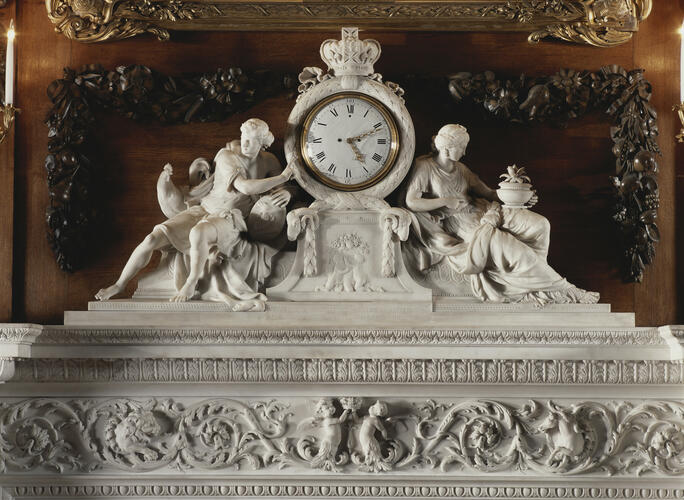
A clock within a gilt-bronze bezel in a crowned laurel wreath resting on an altar with rams' heads at the forecorners and pendant laurel garlands and two putti in relief. The dial is flanked by figures of Vigilance and Patience. The figure of Vigilance holds a profile medallion of Father Time and has a cockerel at his side. The figure of Patience gazes at a potted plam.
The quotation below is taken from William Cowper’s Latin Poems: 'QUÆ LENTA ACCEDIT QUAM VELOX PRÆTERIT HORA! UT CAPIAS PATIENS ESTO, SED ESTO VIGIL' [Slow comes the hour, its passing speed how great! Waiting to seize it - Vigilantly wait.]. According to a letter from Cowper to Lady Hesketh, dated 9 August, 1788, Cowper prepared two mottoes for approval by John Bacon, the sculptor, who made the final selection of which was to appear on the clock (with thanks to the Cowper & Newton Museum, Olney, Buckinghamshire, for this information).
The eight-day rack striking mechanism has a fusee movement and a ½ dead beat escapement. The enamel dial has the 12 hours represented in Roman numerals and 5 minute intervals by arabic numbers and a pair of gilt pierced and engraved hands. Vulliamy number 197Provenance
The chimney–piece and clock were originally commissioned by King George III and Queen Charlotte for the Saloon at Buckingham House. Queen Charlotte held audiences in the saloon and the Latin motto is therefore particularly relevant: royal audiences were long looked forward to events but over in a very few minutes. The clock case was exhibited at the Royal Academy in 1789. Both the chimney and clock case were moved to Windsor Castle following King George IV’s radical rebuilding of Buckingham House in the 1820s. The sculptor John Bacon, originally a porcelain painter and modeller. In 1769 he was awarded the first gold medal for sculpture given by the Royal Academy, for a bas-relief representing the escape of Aeneas from Troy. Other work by him can be seen in Westminster Abbey.
-
Creator(s)
(sculptor)(clockmaker (movement))(designer)(nationality)Acquirer(s)
-
Medium and techniques
Marble, brass, glass
Measurements
102.0 x 83.0 x 33.0 cm (whole object)
Object type(s)
Alternative title(s)
Dial clock


