


-
1 of 253523 objects
Bombay School of Art
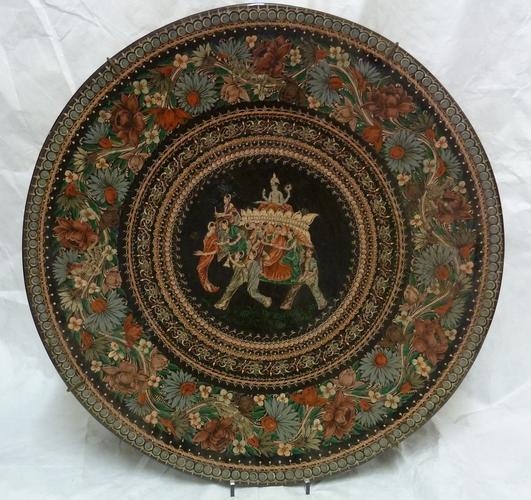
Dish late nineteenth to early twentieth century
Terracotta, slip, glaze | 7.0 x 61.0 x 61.0 cm (whole object) | RCIN 28710
-
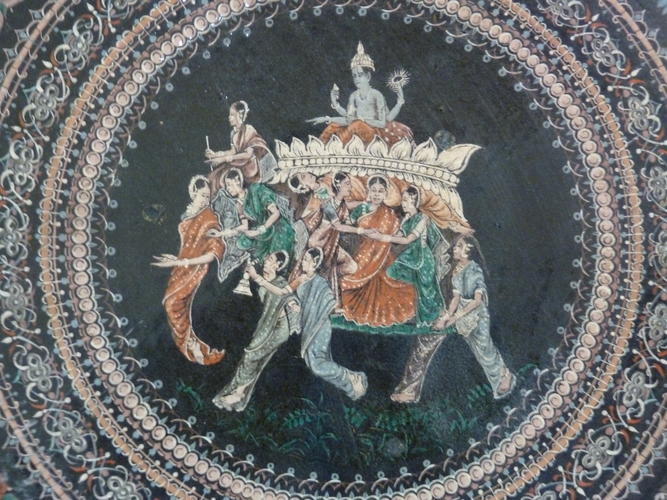
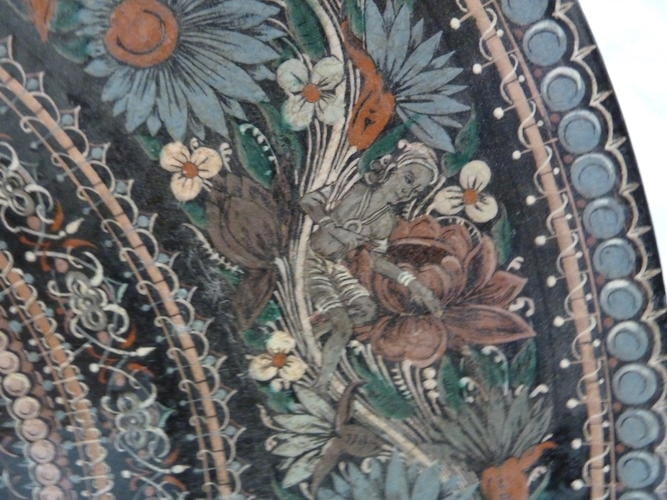
A large circular terracotta dish, slip painted in red, green, blue, orange and white on a brown background. The central scene depicts the Hindu diety Vishnu on a lotus-shaped howdah or seat on the back of a composite elephant made up of nine female attendants in the form of an elephant. The ornate border comprised of lotuses and four figures. The decoration possibly inspired by the frescoes of the Ajanta cave temples in Maharashtra, India, and traditional playing cards decorated with Hindu dieties produced in nearby Sawantwadi.
The Bombay School of Art (or Jamsetjee Jeejeebhoy School of Art) was established in 1857 and produced ceramics from the mid 1870s. Students were encouraged to copy and adapt motifs from local rather than European sources, in an attempt to promote the preservation of 'traditional' Indian art. For example, designs were taken from the Ajanta cave temple murals, which although existent from the 2nd century BC, had remained unknown to Anglo-Indians until 1819. These ceramics were displayed at international exhibitions in the late nineteenth century and sold to the British public by retailers such as Liberty's of London. -
Creator(s)
(nationality) -
Medium and techniques
Terracotta, slip, glaze
Measurements
7.0 x 61.0 x 61.0 cm (whole object)
Place of Production
Mumbai [Maharashtra]


