


-
1 of 253523 objects
Richard James Wyatt (1799-1850)
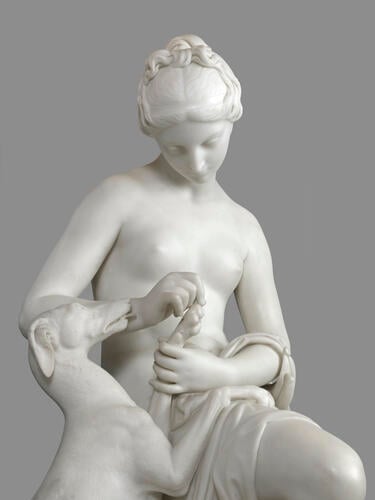
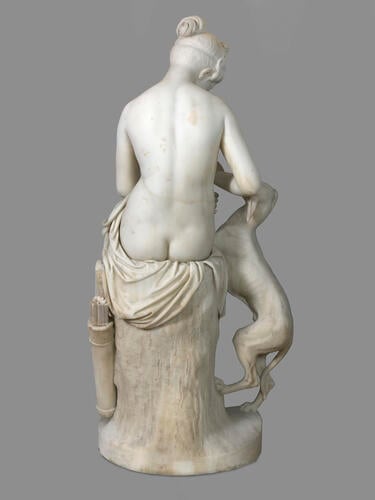
Nymph of Diana Taking a Thorn from a Greyhound’s Foot (‘The Huntress’) 1850
Marble | 140.3 cm (whole object) | RCIN 2052
Grand Staircase, Buckingham Palace
Richard James Wyatt (1799-1850)
The Huntress 1850

-
This partially draped classical female youth is one of Diana’s nymphs. She is depicted seated and removing a thorn from a greyhound’s foot. Her quiver and arrows leaning against the stump indicate that she is a huntress and establish her connection with the goddess Diana.
The composition reflects the period's desire for themes drawn from classical mythology as well as depictions of animals which became fashionable in the nineteenth century. This subject of Diana's nymph was particularly popular amongst wealthy patrons and is one that the artist reworked many times. These were also favourite subjects of Queen Victoria who commissioned the group as a birthday present for her consort, Prince Albert, in 1850.
Queen Victoria had visited the Royal Academy exhibition on 3 May 1849, and admired this group, which was exhibited in plaster (no. 1196). Resolving to order a marble version for her husband, she wrote to John Gibson in July, expressing relief that Wyatt had not been badly hurt in the bombardment of Rome during the recent siege. She continued ‘I wish Wyatt to make for me that statue of the Huntress taking a thorn out of a dog’s foot, that we admired so much in the Exhibition, &… I much wish to have it by next August.’
Gibson kept the queen informed of Wyatt’s progress with the Huntress by means of regular bulletins addressed to Miss Marianne Skerrett (1793–1887), who served the queen as Head Dresser and Wardrobe Woman for twenty-five years. Gibson informed Miss Skerrett that the statue would be finished in February 1850. This must have been one of the last marbles that Richard Wyatt managed to complete before his death on 28 May that year.
The queen’s version was intended for Osborne, where it stood in the Billiards Room. The number of versions attest to its popularity beyond the royal family, and Gibson himself singled it out as ‘indeed a beautiful work'.
This is one of the five works by Wyatt that were acquired for or by Queen Victoria. The first royal purchase of a work by Wyatt was made by Prince Albert in 1841 of a statue of Penelope (RCIN 71423).
Text adapted from Victoria & Albert: Art & Love (2010) and Sculpture in the Collection of His Majesty The King (2025)Provenance
Commissioned by Queen Victoria through John Gibson in July 1849 and presented to Prince Albert on his birthday, 26 August 1850; Osborne, Billiards Room; Windsor Castle, Orangery; Buckingham Palace (1915); Grand Staircase.
-
Creator(s)
Acquirer(s)
-
Medium and techniques
Marble
Measurements
140.3 cm (whole object)
Alternative title(s)
The Huntress


