


-
1 of 253523 objects
Jean Geefs (1825-60)
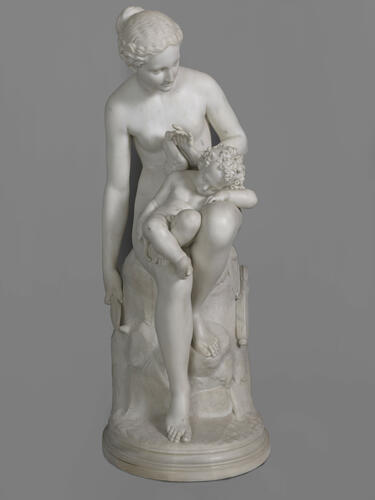
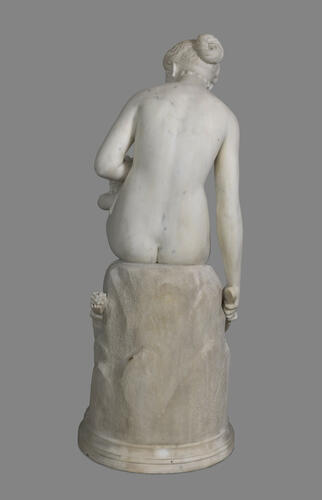
Love and Malice signed & dated 1859
Marble | 130.8 cm (whole object) | RCIN 2051
Grand Staircase, Buckingham Palace
-
A naked full-length female figure of a Nymph seated on tall naturalistic rockwork with a spring gushing from one side into a lively stream. In her lap, the winged, naked Cupid, with curled hair, is asleep, resting his head in the cruck of his left elbow. In his right hand he clutches a bow (with the string wound round it) and an arrow. The Nymph holds the tip of his right wing with the finger and thumb of her left hand, while in her right hand, which is held down against the rock, she clutches a closed pair of shears. Suspended from the rock by a strap is Cupid’s quiver. The circular foot of the group is raised on a separate, moulded circular base
The group represents the chastisement of Cupid by Venus following his marriage to Psyche, as related by Apuleius. Nymphs were often in search of Cupid – the god of love - to punish him for inappropriately shooting his love arrows. Clipping his wings while he was asleep was one of the punishments.
This composition is typical of nineteenth century neo-classical artists who wanted to replicate the idealised forms, simplicity and clarity of lines of ancient sculpture, and recurred to classical mythology as their source of inspiration for subject matter. It was a style that Queen Victoria and Prince Albert enjoyed, and at Osborne House they displayed many of the works by neo-classical artists that they patronised. They particularly liked their ability to depict nudity with decorum and restraint, and to represent emotional subjects without drama.
Jean Geefs (1825-60) was a Belgian sculptor and one of six brothers, two of whom also became accomplished sculptors. Several of Guillaume Geefs' works were acquired by Queen Victoria and Prince Albert. Jean won the Prix de Rome in 1846. By at least 1854 he was based in London, at 10 Warwick Place, Pimlico, sharing the address with his younger brother Charles (1829–1911). In 1854 he modelled a life-size statue of a nymph with a harp, The Queen of the Waters, which was shown at the Royal Academy in 1855. Amour et Malice was exhibited in plaster at the Academy in 1858.
Text adapted from Sculpture in the Collection of His Majesty The King (2025)Provenance
Given to Prince Albert by Queen Victoria on his birthday, 26th August 1859 [Victoria & Albert: Art & Love, London, 2010, pg 462]. Placed by Queen Victoria at Osborne House. Later sent to Windsor Castle.
-
Creator(s)
(sculptor)Acquirer(s)
-
Medium and techniques
Marble
Measurements
130.8 cm (whole object)
Category
Object type(s)
Alternative title(s)
L'Amour et La Malice


