


-
1 of 253523 objects
Pietro Tenerani (1789-1869)
Flora signed & dated 1848
Marble | 157.5 cm (whole object) | RCIN 2050
Grand Entrance & Marble Hall, Buckingham Palace
-
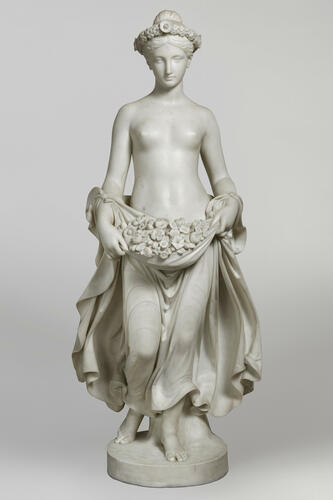
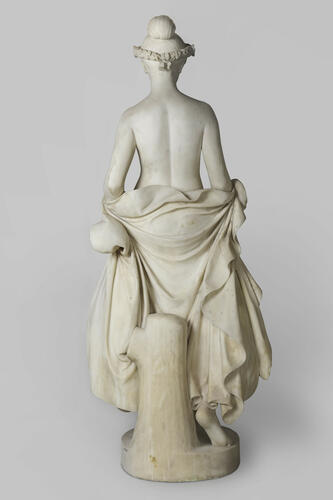
Full length marble statue of Flora (goddess of Spring and of flowers), represented as a young woman, her upper body naked, wearing a garland of stylised flowers in her hair, including jasmine and roses, and holding an abundance of stylised flower heads gathered in drapery across her waist. The drapery spreads in folds to either side as if she were moving forwards, billowing behind her and accentuating the shape of her legs. A tree stump stands behind her on the circular integral base. The back is very summarily carved. Incised on the tree stump: P. TENERANI, FACEVA MDCCCXLVIII.
This is Tenerani’s most successful work of ideal sculpture. It was inspired by an ancient statue of one of the Horae (or seasons) formerly in the Ludovisi collection, and by Antonio Canova’s Hebe (produced 1808–1814). From the former he took the general design, substituting flowers for fruit, and from Canova's work he took the semi-nudity, the lightness and the movement of the drapery. As with contemporary representations of Psyche, much is made of the contrasting upper and lower halves of the body, although here the drapery, blown by the zephyrs that carry the scent of her flowers, follows the profile of the legs so closely that it barely can be said to cover them. Only the abdomen itself is obscured, but by a mass of flowers suggestive of fertility.
Flora was modelled in 1835, and was the fifth example to be made in marble for an international clientele. The first was for Count Rudolph von See. Queen Victoria’s version was acquired through the offices of John Gibson, who wrote from Rome on Christmas Eve 1847 to inform the queen's dresser, Miss Skerrett, that Tenerani had promised ‘to finish the Flora (Spring he calls it) next month Feby.' It was intended to form a pendant to Richard Wyatt’s Glycera (RCIN 75049) at Osborne, where it had arrived by 22 May 1849.
Text adapted from Sculpture in the Collection of His Majesty The King (2025)Provenance
Purchased by Prince Albert in May 1849; Osborne, Billiard Room; Principal Corridor; removed to Windsor after 1901; Buckingham Palace, Grand Hall, 1915
-
Creator(s)
(sculptor)Acquirer(s)
-
Medium and techniques
Marble
Measurements
157.5 cm (whole object)


