


-
1 of 253523 objects
William Theed (1804-91)
Roma signed & dated 1856
Marble | 86.3 cm (including base/stand) | RCIN 2046
Grand Entrance & Marble Hall, Buckingham Palace
-
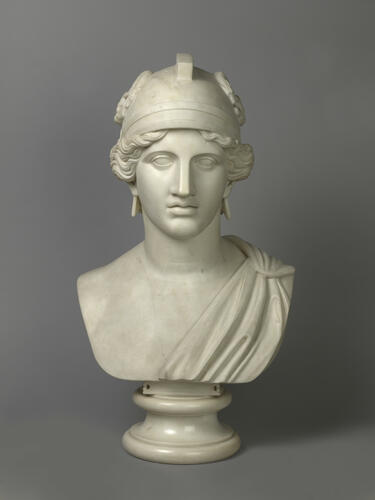
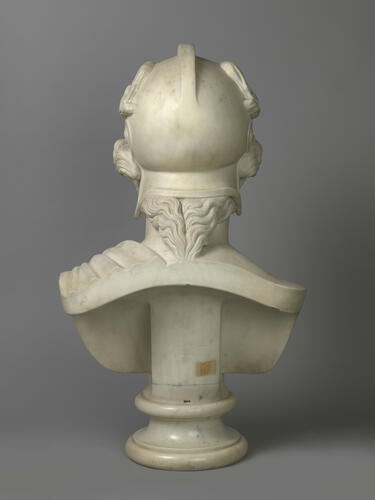
Marble bust of a classical helmeted female, representing Roma. Female facing slightly to her left, wearing a helmet with a central fin and
neck-guard with pointed sides, carved in low relief on the sides with the shewolf suckling Romulus. The wavy hair protrudes in equal masses from the front of the helmet and is gathered to a point at the back. Two lengths of drapery meet over the left shoulder.
In 1856 William Theed received a major commission for Prince Albert, consort of Queen Victoria, which included carving six colossal busts after the antique in white marble, to be placed in the gallery above the grand staircase at Buckingham Palace. These were supplied as part of Theed’s wider work on the sculptural decoration of the new Ball Room, Supper Room and associated galleries, designed by James Pennethorne with the active collaboration of Ludwig Gruner. William Theed was paid £504 for the six busts: ‘Juno’ of the Ludovico Collection in Rome, ‘Aesculapius’, ‘Achilles’, ‘Alexander of the Capitol’, ‘Venus of Arles’ and ‘Roma’.
The commission for the busts first seems to have arisen in the autumn of 1855. Various figures were considered, and by 24 November Theed had delivered casts of six busts to the palace for approval. The image of Roma was used throughout the Roman Empire as a symbol of its beauty and strength. This Roma is based on a bust from the Richelieu collection in the Louvre, Paris (MR 644) of which a cast was evidently procured in Paris by Gruner. Four of the busts, the Achilles, Juno, Roma and Aesculapius, stand on very tall solid marble columns of a pronounced pink colour, apparently ordered through Gruner.
William Theed lived in Rome between 1826 and 1848 where he studied and worked in the workshops of the neo-classical artists Bertel Thorvaldsen, John Gibson and Richard James Wyatt. Following a recommendation from the sculptor John Gibson, Theed received his first commission from Prince Albert in 1847, for two marble statues for Osborne House in the idealised classical style. Encouraged by Gibson, he returned to London in 1848 and became one of the leading and most prolific artists of the period, and favourite of Queen Victoria and Prince Albert. It was with Prince Albert in particular with whom he established a close connection.
Text adapted from Sculpture in the Collection of His Majesty The King (2025)Provenance
Commissioned by Prince Albert in 1855; invoiced in March 1857. Buckingham Palace, Promenade (East Gallery; Juno and (?)Venus in the Picture Gallery Lobby by 1910; the other four in the Picture Gallery by 1914; Marble Hall / Lower Corridor. -
Creator(s)
(sculptor)(nationality)Acquirer(s)
-
Medium and techniques
Marble
Measurements
86.3 cm (including base/stand)
Category
Object type(s)


