


-
1 of 253523 objects
Sir William Reid Dick (1878-1961)
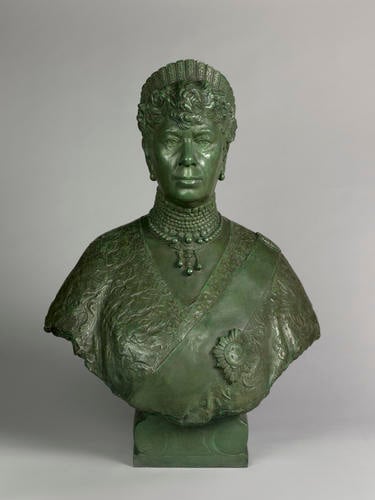
Queen Mary (1867-1953) 1938
Bronze | 80.6 cm (excluding base/stand) | RCIN 2013
Vestibule , Buckingham Palace
Sir William Reid Dick (1878-1961)
Queen Mary (1867-1953) 1938
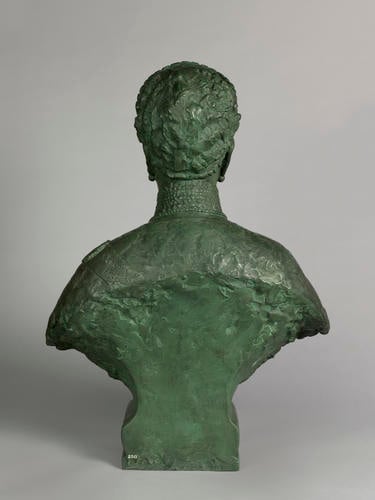
Sir William Reid Dick (1878-1961)
Queen Mary (1867-1953) 1938
-
A bronze bust of Queen Mary, facing front, wearing tiara, pearl earrings, chokers and brocaded dress with the Star and Sash of the Order of the Garter.
Head and shoulders, life size. The head facing straight ahead, with curled hair, wearing a fringe tiara and several necklaces comprising eight strands tightly worn around the neck. Queen Alexandra’s wedding brooch is suspended from the necklace. The bust is clothed in a patterned, textured gown with the ribbon and star of the Order of the Garter. Consistent green patina. Cast inscription on the left shoulder above the ribbon: Reid / Dick / 1938. Integral, rectangular socle incised on the front, suggestive of an ionic capital.
Although she was by now a widow, the queen’s bust was evidently intended as a pair to that of the late king, executed in 1933 (RCIN 2057), with the same vestigial scrolls to the socle. It was modelled in conjunction with the queen’s recumbent effigy, which would join that of the king in St George’s Chapel, Windsor, in 1953.
Reid Dick attended Marlborough House on 5 December 1936, with a photographer. He returned on 25 February 1937 and 3 January 1938, and the queen visited his studio on 30 December 1937 and again on 11 February 1938. During the modelling of the bust two changes were made to the queen’s jewellery. For the initial sittings to the photographer she wore a bandeau tiara with cabochon stones with the pendant brooch worn, as it habitually was, at the breast. So it appears in the clay model, but the bandeau has been substituted by a fringe tiara (probably a simplified representation of Queen Alexandra’s ‘Kokoshnik’ tiara), and the ribbon and star of the Order of the Garter have been added. By the time the bronze was cast, the brooch had been moved to the neck. The finished bust and the effigy in St
George’s Chapel conform exactly in this respect.
The bust was exhibited in plaster at the Royal Academy in 1938 (no. 1449) and in bronze in 1953 (no. 1240), shortly after the queen’s death on 24 March. It would later form a pattern for the bust of Queen Elizabeth (RCIN 100767) completed in 1960. This bust was probably cast by John Galizia in Battersea. A patinated plaster version is in the Government Art Collection, dated 1938. A later cast is in the National Portrait Gallery, London.
Sir William Reid Dick (1878-1961) was a Scottish sculptor, better known for his public monuments. He became an Associate of the Royal Academy in 1921, and a Royal Academician in 1928. Dick served as President of the Royal Society of British Sculptors from 1933 to 1938 and was Sculptor in Ordinary for Scotland to George VI from 1938.
Text adapted from Sculpture in the Collection of His Majesty The King (2025)Provenance
Commissioned by Queen Mary in 1936; Buckingham Palace, Picture Gallery Vestibule
-
Creator(s)
-
Medium and techniques
Bronze
Measurements
80.6 cm (excluding base/stand)
80.4 cm (whole object)
Category
Object type(s)


