


-
1 of 253523 objects
Amduat (the first hour) 300 - 275 BC
61.5 x 80.5 cm (mount) (whole object) | RCIN 1145266

-
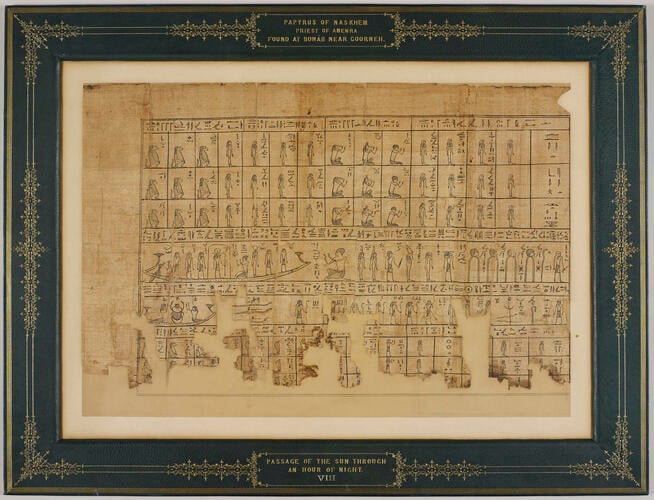
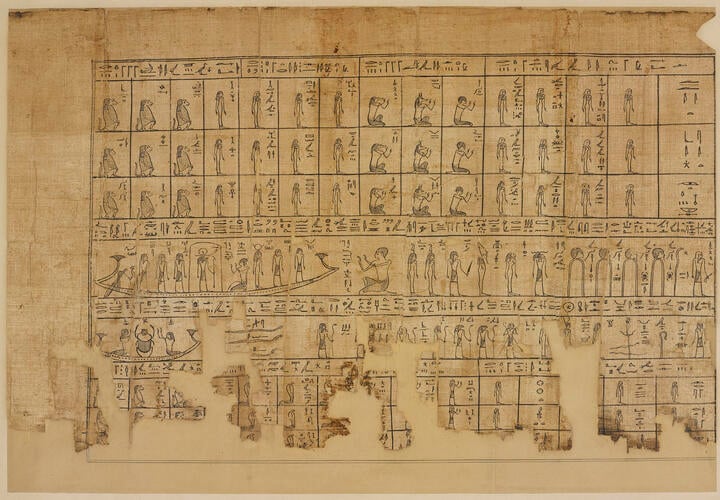
This papyrus is one of eight fragments from a scroll of the Amduat, meaning ‘that which is in the netherworld’ (RCINs 1145259-1145266). Also known as the Book of the Hidden Chamber, it is an Ancient Egyptian funerary text describing the journey of regeneration of the sun god Ra through the 12 hours of the night, from sunset (symbolising death) to sunrise (symbolising rebirth). The Amduat started to appear in royal tombs around 1500 BC, two notable examples being the burial chambers of Thutmose III (1479-1425 BC) and Amenhotep II (1427-1400 BC) in the Valley of the Kings (near the modern city of Luxor). It represents an important stepping stone in the literary tradition of Ancient Egypt, maintaining its relevance well into the Graeco-Roman era.
The main aim of the Amduat is to familiarise readers with the netherworld, so that the deceased may gain valuable knowledge about what obstacles and demons could hinder safe passage, as well as which deities and beings would be able to help completing the journey of regeneration.
This fragment describes the first hour of the night journey, introducing important and typical beings of the netherworld. They include groups of nine gods alternating with groups of twelve goddesses, as well as solar baboons who are the traditional entourage of the sun god Ra, accompanying him with music and dance. They will open the gates of the netherworld.
Ra is represented twice in the papyrus: in the upper sub-section of the middle register he appears as a ram-headed god, within a shrine at the centre of his solar barque (a vessel called Mesektet). In front of him is the adoring deceased. In the lower sub-section, which in part duplicates the previous representation, Ra is in his solar barque as a scarab beetle, worshipped by two kneeling figures who represent the god of the afterlife, Osiris. As the two depictions present both the nocturnal (ram-headed) and rejuvenated morning (scarab beetle) forms of the sun god, the Amduat makes clear from the beginning that regeneration is the central message of the text.
This fragment was once part of a papyrus scroll made for ‘God’s Father and Priest of Amun-Ra, King of the Gods, Nesmin, born of the Lady of the House, Sistrum-player of Amun-Ra, Tasherit(en-ta)ihet’. The scroll was discovered in 1862, attached with bitumen to Nesmin’s mummy excavated at the Dra’ Abu el-Naga’ necropolis near Deyr el-Bahri. Only the first eight hours of the text survive, perhaps as a result of the contamination with bitumen. The excavation was conducted by Mustafa Aga Ayad, consular agent to the United Kingdom, under special permission of Said Pasha, the Viceroy of Egypt. It was attended by Albert Edward, Prince of Wales (the future King Edward VII), who was then touring the Middle East. Following its discovery, Albert Edward was allowed to take the papyrus back to England, where it was cut according to textual divisions (as was standard practice at the time) and mounted by Charles Tuckett of the British Museum’s Bindery. It remains in this form today.
Further reading
Samuel Birch, Description of the papyrus of Nas-Khem, priest of Amen-ra (London, 1863) (see RCIN 1079232)
For a recent English translation, see The Egyptian Amduat. The Book of the Hidden Chamber, edited by E. Hornung and T. Abt (Zurich, 2007).Provenance
Buried with the priest Nesmin (late 3rd century BC); excavated in Egypt at the Dra’ Abu el-Naga’ necropolis in 1862; acquired by Albert Edward, Prince of Wales (later King Edward VII) in the same year.
-
Measurements
61.5 x 80.5 cm (mount) (whole object)
37.9 x 60.5 cm (sheet of paper)
86.5 x 67.0 cm (book in box)
Category
Alternative title(s)
Section of the papyrus belonging to Nesmin, with the first hour of the Amduat
Passage of the sun through an hour of the night ; 8. (Papyrus of Nas-Khem Priest of Amen-Ra).


