


-
1 of 253523 objects
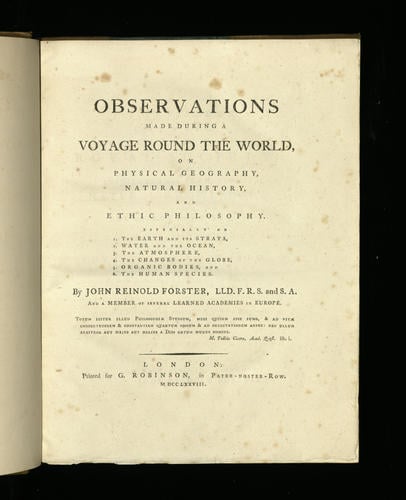
Observations made during a voyage round the world on physical geography, natural history and ethic philosophy ... / by Johann Reinhold Forster. 1778
RCIN 1141426
Johann Reinhold Forster (1729-98)
Observations made during a voyage round the world on physical geography, natural history and ethic philosophy . . . / by Johann Reinhold Forster 1778
-
This is a copy of the observations made by Johann Reinhold Forster (1729-1798), the German pastor and scientist who accompanied Captain James Cook's second voyage to the Pacific. Forster, accompanied by his son, was selected to join the expedition following a disagreement between Joseph Banks and the Royal Society. The observations made by both Forster and his son were invaluable in the understanding of Pacific Islander life and the botany and geography of this hitherto unknown region.
Cook's second voyage was the voyage that cemented his reputation as a navigator. Although the Endeavour voyage of 1769-71 confirmed that New Zealand was an archipelago and charted the east coast of Australia, some members of the Royal Society still believed in the existence of a Terra Australis incognita, an unknown southern continent. Cook was commanded to find this continent in a new expedition with the ships HMS Resolution and HMS Adventure.
The ships left Plymouth in July 1772 and sailed towards the Antarctic Circle, crossing it for the first time in January 1773. Antarctic fog and sea-ice separated the two ships in February and both sailed to a rendezvous in New Zealand that had been charted by Cook three years previously.
On the way to New Zealand, the Adventure, commanded by Tobias Furneaux, surveyed the southern coast of Van Diemen's Land (now Tasmania) before reaching the rendezvous in mid-March 1773. Cook arrived with the Resolution in May 1773. From June, both ships sailed across the South Pacific, making stops at Tahiti, Ra'iatea and Tonga before returning to New Zealand where the Adventure made for home. At Ra'iatea, the expedition picked up a young Polynesian man named Omai (or Mai) who travelled with the Adventure to London, arriving in November 1774. Omai spent two years in London where he was much admired and was introduced to many influential figures of the age, including George III. Cook returned him to Ra'iatea in 1777. Mai's time in London is problematic, he appears to have been brought back to Britain as a curiosity, a living example of the idea of the 'noble savage' which was popular in Europe at the time. Pacific Islanders were seen as living idyllic lives compared to the busy industrial lives of Europeans. This perception of the Pacific as a 'paradise' continues to persist, but these ideas neglected the complexity of Islander societies and the often violent nature of politics among different communities in the Pacific.
After the departure of Adventure, Cook left New Zealand in order to further explore the Antarctic Circle. Resolution made two more penetrations into the sea-ice but was forced to return northwards in late January 1774. Cook then made several further sweeps of the Pacific, making stops at Easter Island, Tonga and several other islands and atolls across the ocean.
Provenance
Re-bound by Riviere in the mid-nineteenth century. Possible it is the copy listed in the catalogue of the personal library of George III at Cumberland Lodge.
-
Creator(s)
(publisher)(binder)


