


-
1 of 253523 objects
India
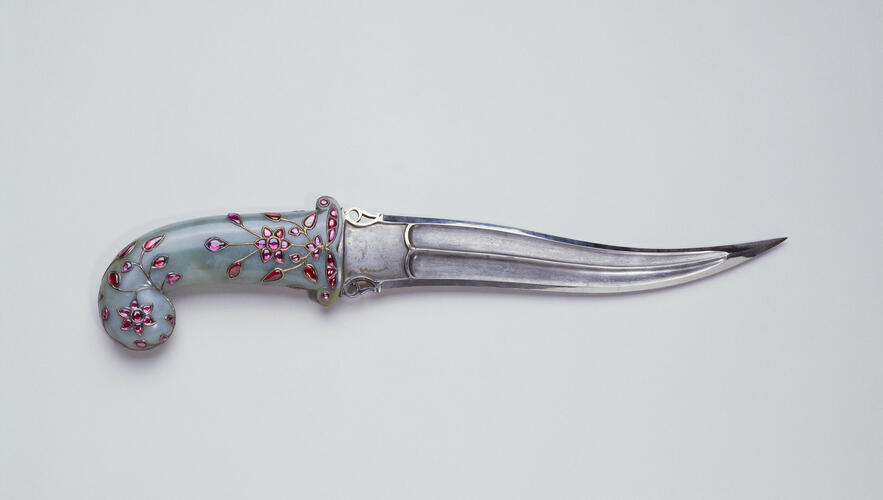
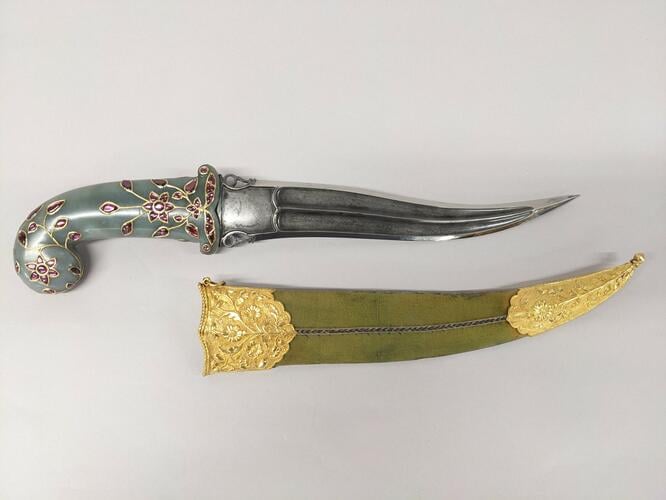
Khanjar (Dagger) 1800-75
Watered crucible steel, jade, gold, garnets | 37.6 x 6.4 x 2.3 cm (whole object) | RCIN 11361
-
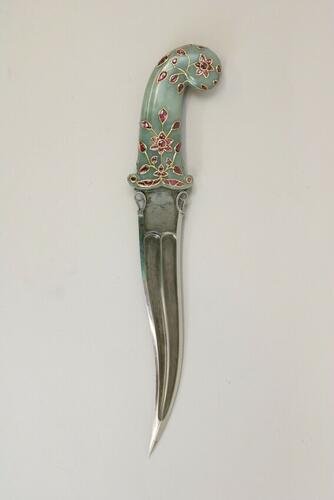
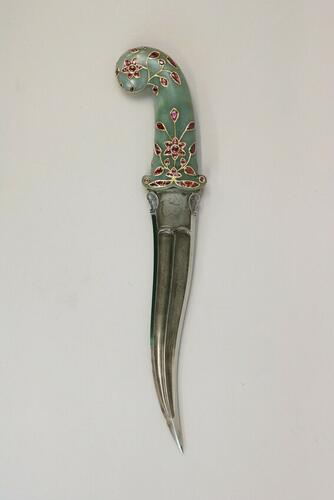
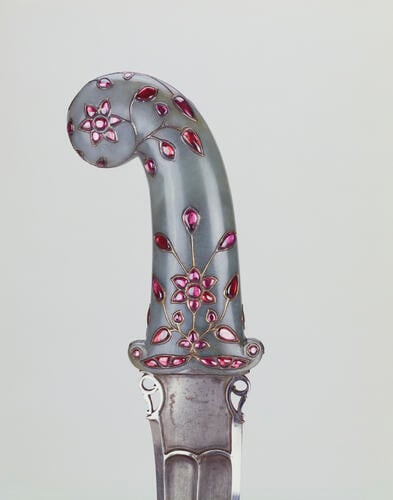
A khanjar with a two edged re-curved blade. The blade is thickened at its point and chiselled with two deep grooves on each side. The hilt carved out of jade is inlaid with garnets arranged in a floral design. The form and style of decoration of the hilt suggests it was made in the Mughal empire, which by the late eighteenth century stretched from modern-day Afghanistan to Bangladesh. The use of jade within India increased during the reign of Alamgir (r.1658-1707) after trade routes into modern-day Hotan in China became accessible to the Mughal court. Jade has been traded in Hotan since 5000 B.C. This dagger may have reached Nepal from India as a diplomatic gift.
The hilt is possibly early nineteenth century with later Kundan gem settings, blade and scabbard from Kutch. The scabbard of wood covered in green silk velvet, with a gold chape and locket, chased in low relief with floral designs (RCIN 11340) is described in Purdon-Clarke 1898 but illustrated separately (Case display B).
Purdon-Clarke, C. 1898. Indian Art in Marlborough House The Collection of Indian Arms & Objects of Art presented by the Princes & nobles of India to HRH the Prince of Wales on the occasion of his visit to India 1875-76. London, W Griggs. Cat No 23.
Meghani, K. 2017. Splendours of the subcontinent pp.122-123 (Khanjar only)Provenance
Presented to King Edward VII, when Prince of Wales, during his tour of India in 1875-76 by Bir Narsingh Kunwar, Maharaja Jung Bahadur Rana [Prime Minister] of Nepal.
-
Creator(s)
(nationality)Acquirer(s)
-
Medium and techniques
Watered crucible steel, jade, gold, garnets
Measurements
37.6 x 6.4 x 2.3 cm (whole object)
Alternative title(s)
Khanjar


