


-
1 of 253523 objects
Narrative of a journey to the shores of the Polar Sea in the years 1819, 20, 21 and 22 / by John Franklin, Captain... 1823
RCIN 1124418
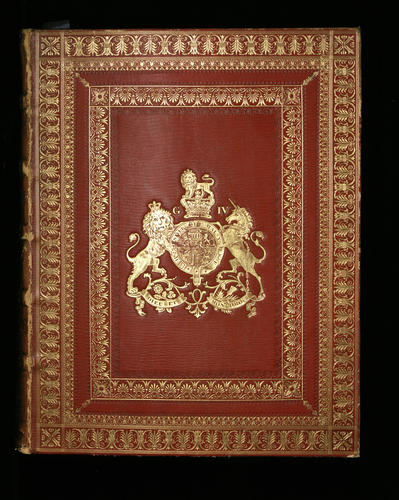
Sir John Franklin (1786-1847)
Narrative of a journey to the shores of the Polar Sea in the years 1819, 20, 21 and 22 / by John Franklin, Captain. . 1823
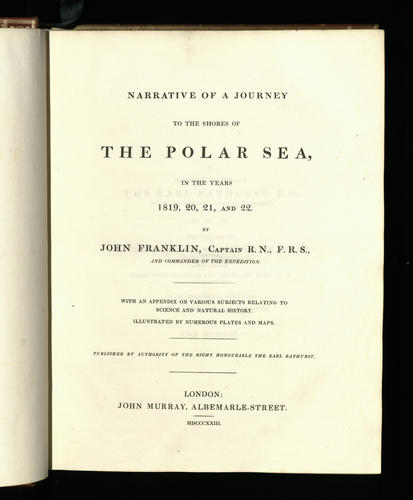
Sir John Franklin (1786-1847)
Narrative of a journey to the shores of the Polar Sea in the years 1819, 20, 21 and 22 / by John Franklin, Captain. . 1823
-
This book, from the library of George IV, contains Sir John Franklin's account of his first voyage to the Canadian Arctic between 1819 and 1822. The voyage was intended to discover the Northwest Passage, a proposed route to the north of North America connecting the Atlantic and Pacific Oceans. The discovery of the Northwest Passage would be incredibly beneficial to global trade as it would have provided a shorter passage for ships travelling from China and India to Europe.
Franklin's expedition was also intended to better survey the river networks of Rupert's Land, territory in central Canada administered by the Hudson's Bay Company. These river networks allowed Hudson's Bay traders to penetrate deep into the Canadian interior to take advantage of the natural resources in those lands, travel by land being treacherous.
The expedition travelled down the Coppermine River (now in the present-day Northwest Territories and Nunavut) towards the Arctic Ocean but it did not go to plan. Franklin expected assistance from local fur traders and Indigenous populations, but neither was very willing, while harsh weather and poor supply lines also badly affected the party. The expedition was able to explore only around 500 miles of uncharted land before being forced to retreat due to starvation. The journey back to the safety of Hudson's Bay forts has become infamous. The men were forced to survive by eating lichen from rocks and even the leather of their boots, not eating meat for well over a month.
The account also describes in great detail the dramatic events of October 1821 when Franklin split the company in order to have a better chance of surviving the ordeal. Two of the explorers, Robert Hood and John Richardson were both suffering from the effects of starvation and hypothermia and were too weak to carry on. Franklin, although worried at the prospect of leaving two of his team to their fate, reluctantly agreed to move ahead, sending the fittest of the expedition further ahead to collect provisions from Fort Enterprise. Soon after he left Hood and Richardson (as well as an attendant, John Hepburn), four voyageurs (French Canadian and Métis traders who specialised in canoe travel) accompanying Franklin informed him that they were too exhausted and decided to return to the two men. However, only one of these men, Michel Terohaute, arrived back at the camp. Terohaute stated that his fellow voyageurs were slow from exhaustion and that he had decided to march ahead, confident that they would arrive soon. Being a skilled hunter, he had miraculously acquired some meat and helped to feed the two men in order to sustain them.
According to the account, once the meat had been consumed, Terohaute began to act strangely, he refused to assist in the foraging for lichen and arguments ensued. Soon, Hood and Richardson, along with Hepburn, began to suspect that Terohaute had killed the other voyageurs and had eaten them, before feeding the three men human flesh in order to restore their health. Some days later, while Richardson and Hepburn were foraging, Terohaute shot Hood, much to the shock of the others. Being much stronger than the two men, he held them captive for several days until on 23 October he left them to gather some lichen, whereupon Richardson loaded a pistol and killed Terohaute as soon as he returned.
This was, and remains, a controversial report. Franklin only had the testimony of Richardson and Hepburn, and once the survivors returned to England, rumours began to spread that perhaps the two surviving men were actually the culprits of the horrific events and that they had blamed Terohaute, a man who would have known the territory well and therefore unlikely to resort to such extreme actions, in order to avoid suspicion.
The emaciated men managed to re-join the rest of the party at Fort Enterprise, which to their shock, was unsupplied. Eventually, the remaining party, eleven of a team of twenty, were rescued by George Buck, whom Franklin had sent ahead, and a group of the Indigenous Yellowknife (T'atsaot'ine) peoples and delivered to Fort Providence on 11 December 1821. -
Creator(s)
(publisher)


