

-
1 of 253523 objects
Gleanings from the Menagerie and Aviary at Knowsley Hall. 1846-50
57.5 x 5.0 cm (book measurement (inventory)) | RCIN 1083427
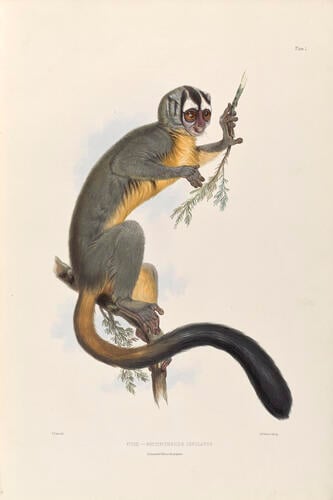
Edward Smith-Stanley, 13th Earl of Derby (1775-1851)
Gleanings from the Menagerie and Aviary at Knowsley Hall 1846-50
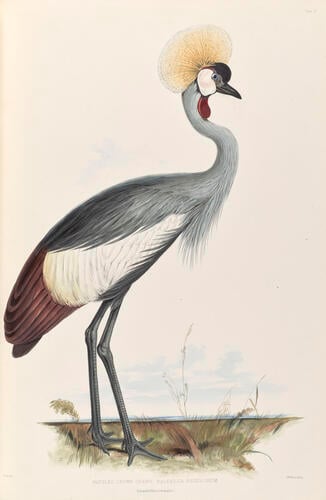
Edward Smith-Stanley, 13th Earl of Derby (1775-1851)
Gleanings from the Menagerie and Aviary at Knowsley Hall 1846-50
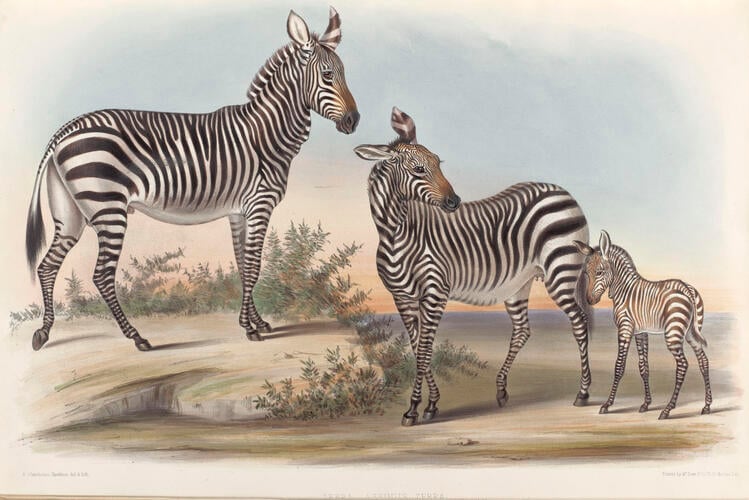
Edward Smith-Stanley, 13th Earl of Derby (1775-1851)
Gleanings from the Menagerie and Aviary at Knowsley Hall 1846-50
Edward Smith-Stanley, 13th Earl of Derby (1775-1851)
Gleanings from the Menagerie and Aviary at Knowsley Hall 1846-50
-
After succeeding his father as 13th Earl of Derby in 1834, the Whig politician Edward Stanley gradually moved away from politics and focused his efforts on his love of the natural world. He served as president of the Zoological Society of London from 1831 and in that role encouraged the collecting of new species from around the world and subsequent developments in taxonomy. He supported lectures by naturalists and explorers and chaired society meetings. Derby also contributed his own articles to the Zoological Society’s proceedings and donated specimens to its collections.
At his home, Knowsley Hall, near Liverpool, Derby built an extensive menagerie where he cared for and bred rare animals, several of which are now extinct. He was the first person to breed in captivity the nene (or Hawaiian goose, Branta sandvicensis) and passenger pigeon (Ectopistes migratorius), among many others.Costing between £10,000 and £15,000 annually to maintain, at Derby’s death in 1851, the menagerie housed some 345 mammals of 94 species and 1,272 birds of 318 species. Some of the animals were subsequently given to the gardens of the Zoological Society. The remainder was sold at auction in October 1851, raising £7,000. A selection of the birds was bought by Queen Victoria at the sale. Derby also maintained a significant museum of some 20,000 specimens, several of which are type specimens. While some specimens were donated to the British Museum before 1851, the bulk formed the collection of the Derby Museum (now the World Museum, part of National Museums Liverpool).
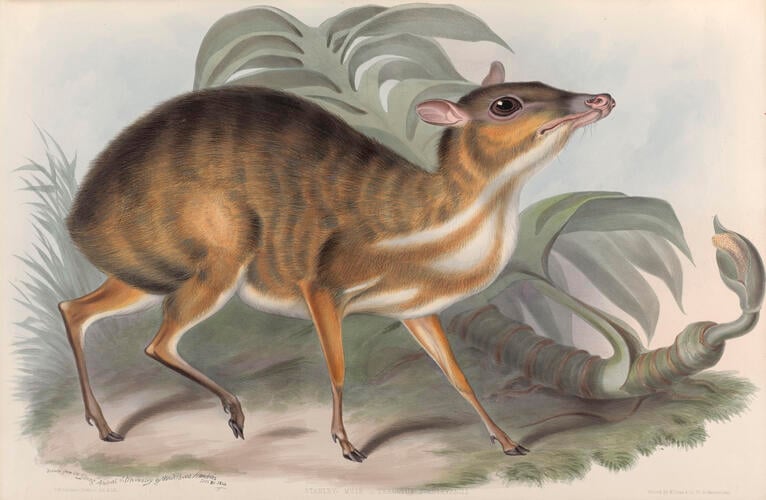
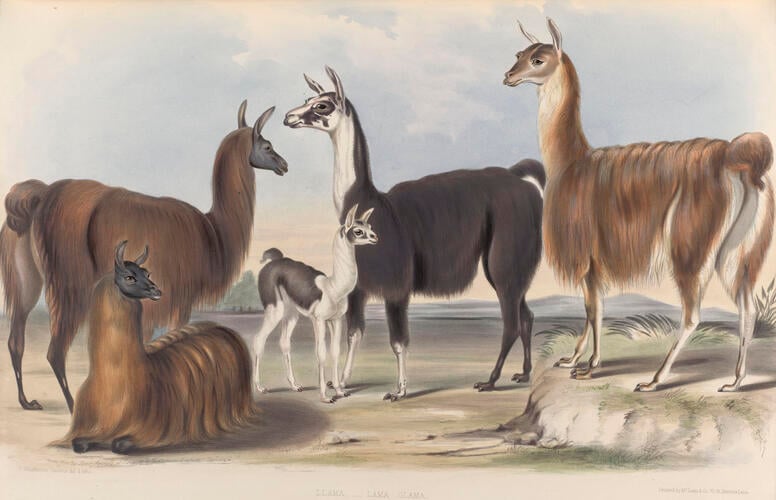
Derby took a personal interest in the care of the animals, and he kept notes recording daily events. He also allowed natural history artists such as Joseph Wolf and Edward Lear to draw and paint from the living animals and the skins found in his museum. Following the end of Lear’s work providing illustrations for John Gould’s Birds of Europe (1832-7), Derby commissioned the artist to paint various animals in his own collection. Lithographs were made from seventeen of these and published in 1846 with text from Derby’s own notes, edited by John Edward Gray. Titled, Gleanings from the Menagerie and Aviary of Knowsley Hall, the volume provides a snapshot of this important collection. Lear grew close to Derby’s family, and it was for the earl’s grandchildren that he devised his famous nonsense poems in the 1840s.
A second volume of Gleanings, focusing on Derby’s comprehensive collection of antelopes, illustrated with lithographs from drawings by Benjamin Waterhouse Hawkins was intended to be published in 1847. However, a series of delays meant that it was not published until 1850, greatly expanded to include other grazing animals such as gazelles, deer, llamas and zebra.The Royal Library’s copy of Gleanings has had both volumes bound together into one large folio, with the letterpress for the first part bound at the front of the book and that of the second bound towards the end. The plates have not been bound in order: Lear’s featuring in two blocks (plates I-VI and then VII-XVII) between those of Hawkins. The volume was re-bound in the reign of King George V, but the title page of the 1850 work indicates that that part at least was presented to the Royal Library by Gray.
-
Creator(s)
(lithographer)(printer)(printer)Acquirer(s)
-
Measurements
57.5 x 5.0 cm (book measurement (inventory))
Category


