


-
1 of 253523 objects
The Letters of Gertrude Bell ; v.1 / selected and edited by Lady Bell. 1927
24.0 x 4.0 cm (book measurement (inventory)) | RCIN 1081064
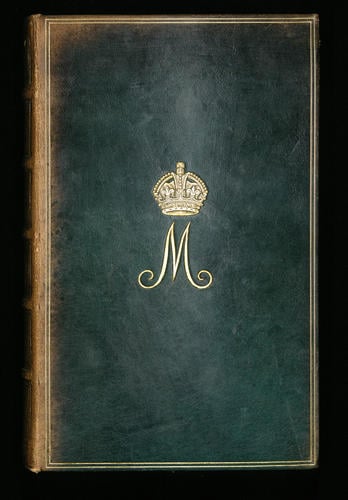
Gertrude Bell (1868-1926)
The Letters of Gertrude Bell ; v. 1 / selected and edited by Lady Bell 1927
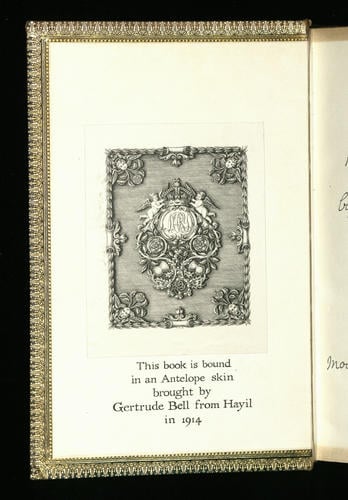
Gertrude Bell (1868-1926)
The Letters of Gertrude Bell ; v. 1 / selected and edited by Lady Bell 1927
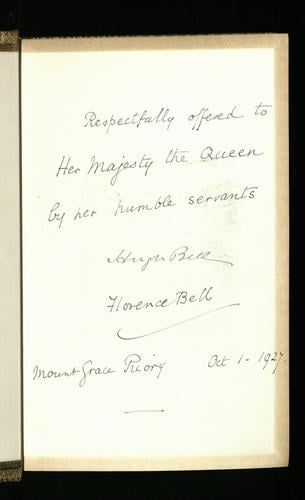
Gertrude Bell (1868-1926)
The Letters of Gertrude Bell ; v. 1 / selected and edited by Lady Bell 1927
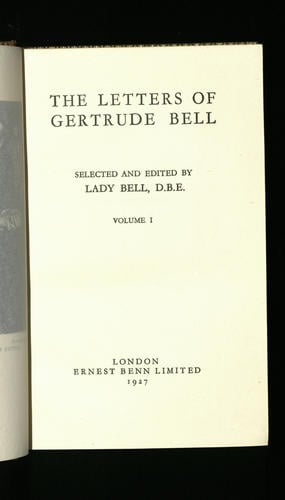
Gertrude Bell (1868-1926)
The Letters of Gertrude Bell ; v. 1 / selected and edited by Lady Bell 1927
-
This collection of letters by the spy, archaeologist, politician and writer Gertrude Bell was edited by her stepmother following her sudden death in 1926. It was presented to Queen Mary by Bell's father and stepmother, and is bound in antelope skin obtained by Bell in the Rashidi capital of Ha'il (now part of Saudi Arabia) where she had visited in 1913.
Gertrude Bell was born in Washington, County Durham in 1868 to Sir Hugh Bell, son of Sir Lowthian Bell, iron entrepreneur and director of the project to construct the Forth Bridge. During her childhood Bell formed a close relationship with her father, often helping him with the administration of his businesses in the North East of England.
From 1892 she spent most of her time travelling the world, taking particular interest in the history and archaeology of the territories of the Ottoman Empire, Persia (Iran), and the numerous emirates in the Arabian Peninsula. Her works, like those of her contemporary and associate, TE Lawrence, described the contemporary Middle East to European readers and were very popular in their day.
Following the end of the First World War, due to her extensive knowledge of the region and its history, Bell was employed by the British government to aid in the creation of the new state of Iraq. Between 1921 and 1926 she took an active role in the education of Iraqi women, helped in the foundation the Baghdad Archaeological Museum (now the National Museum of Iraq) and between 1921 and 1924 served as president of what was to become the National Library of Iraq. She strongly advocated for increased Iraqi independence but, like many colonial officials during the period, she believed that this could only happen with British guidance.
In 1922, Bell was appointed Director of Antiquities by King Faisal and among the reforms she introduced in the role was the restruction of the illegal exportation of archaeological finds to institutions around the world. While this was a move in the right direction, Bell retained the right to decide which artefacts would remain in Iraq and which could be sent overseas for further study. Her law was also seen by Iraqi nationalists as favouring the British, as many permits to excavate archaeological sites in the country were granted to British institutions, rather than the excavations being directed by Iraqi authorities.
Provenance
Presented to Queen Mary by Sir Hugh Bell and Lady Florence Bell, Oct 1 1927.
-
Creator(s)
(publisher)Acquirer(s)
-
Measurements
24.0 x 4.0 cm (book measurement (inventory))


