


-
1 of 253523 objects
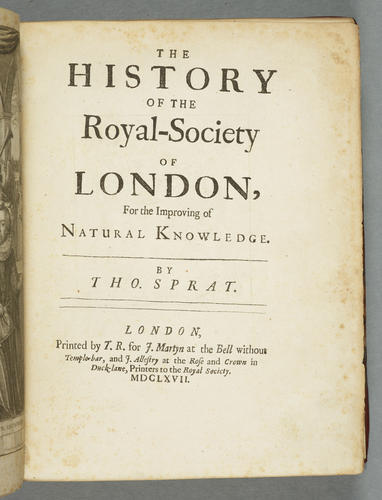
The History of the Royal Society of London for the Improving of Natural Knowledge 1667
23.7 x 18.6 x 4.5 cm (book measurement (conservation)) | RCIN 1057783
-
The Royal Society was founded in 1660 by a group of natural philosophers who agreed that knowledge should be gained from observation and experiment, rather than from preconceived theories. Charles II granted the Society a royal charter in 1662, and the reigning monarch has been the patron ever since. In the 1660s the Society had varied interests, from the nature of gravity, to investigating whether a spider could be captured within a circle of ground unicorn horns.
Only three years after the foundation of the Royal Society, its history was commissioned from Thomas Sprat, a poet and churchman who was later to become Bishop of Rochester. Printed in 1667 after various delays, Sprat's History aimed to describe the Society's methods and purpose, and to respond to concerns that its new focus on experiment challenged contemporary belief systems. The book is in three parts: Sprat first outlines the history of science so far; secondly he gives the early history of the Royal Society, including records of several experiments and enquiries, such as 'Mr. Rook's Discourse Concerning the Observations of the Eclipses of the Satellites of Jupiter' and 'The History Of Making Gun-Powder'; and thirdly he justifies the scientists' work and methods as beneficial to contemporary society.
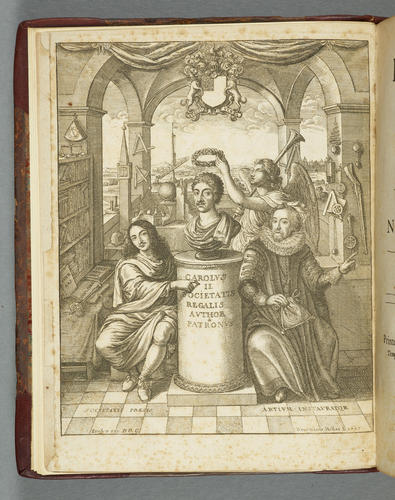
The History opens with a frontispiece designed by Society member John Evelyn and etched by the noted engraver Wenceslaus Hollar. It depicts a bust of Charles II on a pedestal, being crowned with a wreath by the figure of Fame. To the left of the king is William, 2nd Viscount Brouckner, the Society's first president, and to the right is Francis Bacon, who receives fulsome praise from Sprat in the History. In the background can be seen books and scientific instruments, and a large telescope. The centrality of Charles II in the frontispiece reflects the words of Sprat, who, in the History, praises the king's support as freeing mankind from the 'bondage of Errors … a greater Glory than to enlarge Empire' (p. [6]).
Charles's support of the Royal Society was crucial to its early success. For him, it was a source of intellectual fascination, a tool for improving his navy and army, and a way of identifying himself with other powerful European princely patrons of science, such as Louis XIV and the Medici Grand-Dukes of Tuscany. For the Royal Society, Charles gave their studies authenticity, both with his royal charter and by making science a fashion at court. The court heard scientific lectures in the evenings, and Charles had a private laboratory in his palace at Whitehall. He sent items to the Royal Society for its Fellows to investigate, including lodestones, a narwhal's horn and a vial of 'Florence poyson'. Charles II's support for the Royal Society can also be seen in his acquisition of its members' publications. Amongst those kept at his personal library at Whitehall were copies of Robert Hooke's Micrographia and John Evelyn's study of trees, Sylva.
Charles II's own copy of Sprat's History of the Royal Society was part of his private library at Whitehall, much of which is now in the British Library. This copy was acquired for the Royal Library at Windsor Castle by the librarians of William IV, when the modern Royal Library was being established in the 1830s.
Charles did not always take scientific pursuits seriously. His levity is clear in his attitude towards Royal Society members. In February 1664 the diarist Samuel Pepys recorded how the king laughed 'mightily' at the Fellows of the Royal Society 'for spending time only in weighing of ayre, and doing nothing else since they sat' (Pepys 1893-9, IV, pp. 28-9, 1 February 1664), and in 1668 it was reported that Charles referred to the fellows of the Royal Society as his fools, or court jesters. However, whatever his more private thoughts about his scientists, his public patronage of them enhanced both the Society's glory, and his.
Further Reading
Charles II: art & power (London: 2017)
Provenance
Acquired by William IV, 1830-37
-
Creator(s)
(publisher)(publisher)(designer)Acquirer(s)
-
Measurements
23.7 x 18.6 x 4.5 cm (book measurement (conservation))
Other number(s)
ESTC : English Short Title Catalogue Citation Number – ESTC R16577Alternative title(s)
The History of the Royal-Society of London, for the improving of natural knowledge.
London: Printed by T.R. for J. Martyn at the Bell without Temple-bar, and J. Allestry at the Rose and Crown in Duck-lane, Printers to the Royal Society. MDCLXVII


