


-
1 of 253523 objects
England's grand memorial. 1680
54.0 x 41.0 cm (whole object) | RCIN 1027843.e
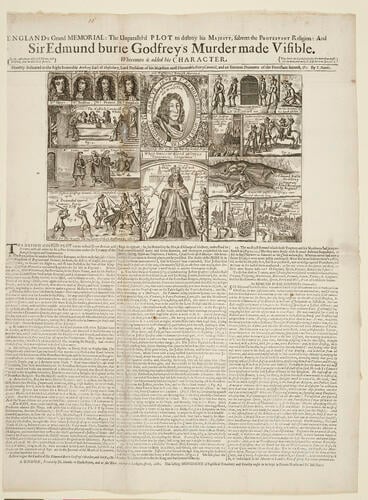
Master: 17th-century pamphlets. Item: England's grand memorial : the unparallel'd plot to destroy his Majesty, subvert the Protestant religion : and Sir Edmund burie Godfrey's murder made visible. Whereunto is added his character. Humbly dedicated to the Right honourable Anthony Earl of Shaftesbury Lord President of his Majesties most Honorable Privy Council, and an eminent promoter of the Protestant interest, &c 1680
-
England's grand memorial : the unparallel'd plot ... [1] sheet : ill. 1680. Broadside. Letterpress and engraving.
The Popish Plot of 1678 was a conspiracy which claimed that there was a Catholic plan to assassinate Charles II. Titus Oates was the chief instigator of the unfounded allegations. In the September, the businessman and magistrate Sir Edmund Berry Godfrey took Oates' deposition. Godfrey was reluctant to be involved, fearful of the consequences of association with the plot. On 12 October he disappeared, and five days later his body was found. He appeared to have been strangled and run through with a sword. Later assessments have concluded that his death may have been suicide covered up by his family, but at the time his demise was seen as confirmation of the validity of the claims of a plot: he was presumed to have been murdered and was glorified as a Protestant martyr.
Pamphlet literature such as this broadside fuelled conspiracy fears. Titled in part 'Sir Edmund bury Godfrey's Murder made visible', it was first printed by Thomas Dawks in 1679, and it was designed to highlight the supposed Catholic threat. Sir Edmund Berry Godfrey is depicted at the centre top, with the Fire of London shown behind him. (The Great Fire was also thought by some, erroneously, to be part of a Catholic plot.) Shown below Godfrey is an image of Charles II threatened by assassins, and surrounding are supposed scenes from the Popish Plot, the murder of Godfrey, and the trial and execution of those accused of carrying it out. Three columns of text underneath the images give the alleged details of the plot and of Godfrey's death, along with a glowing biography of him.
At the foot of this broadside, Dawks advises that this 'lasting monument of Papistical Treachery and Cruelty ought to be kept in Private Houses and Publick Places.' He would also describe it in advertisements as 'a neat Ornament for Gentlemens Houses'. He dedicated 'England's grand memorial' to Anthony, Earl of Shaftesbury, leader of the opposition party that would later become the Whigs and which opposed the succession of the Catholic James II, who was Charles II's brother and heir to the throne. Dawks' production contributed to the anti-Catholic feeling of the time.
Broadside. Letterpress and engraving.
London: printed by Th. Dawks in Black-fryers, and at the Blew Anchor in Ludgate-street, 1680.Provenance
Acquired for the Royal Library in the late-19th or early-20th century
-
Creator(s)
(printer) -
Measurements
54.0 x 41.0 cm (whole object)
Category
Other number(s)
ESTC : English Short Title Catalogue Citation Number – ESTC R7634Alternative title(s)
England's grand memorial : the unparallel'd plot to destroy his Majesty, subvert the Protestant religion : and Sir Edmund burie Godfrey's murder made visible. Whereunto is added his character. Humbly dedicated to the Right honourable Anthony Earl of Shaftesbury Lord President of his Majesties most Honorable Privy Council, and an eminent promoter of the Protestant interest, &c.


