


-
1 of 253523 objects
Padshahnamah پادشاهنامه (Book of the Emperor) 1656-57
58.6 x 36.8 cm (book measurement (conservation)) | RCIN 1005025
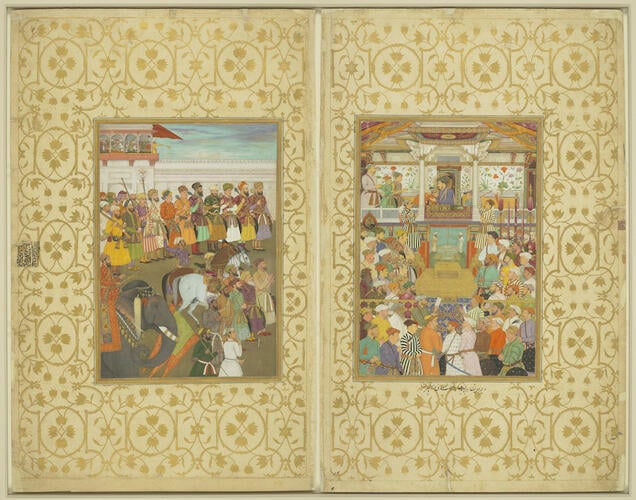
Abd al-Hamid Lahawri
Master: Padshahnamah پادشاهنامه (The Book of Emperors) Item: Shah-Jahan receives his three eldest sons and Asaf Khan during his accession ceremonies (8 March 1628) 1656-57
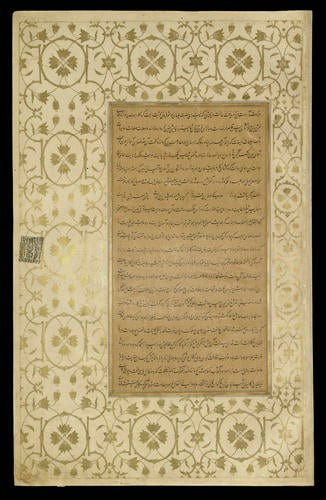
Abd al-Hamid Lahawri
Master: Padshahnamah پادشاهنامه (The Book of Emperors) Item: Text block of the Padshahnama manuscript 1656-57
Abd al-Hamid Lahawri
Master: Padshahnamah پادشاهنامه (The Book of Emperors) Item: Text block of the Padshahnama manuscript 1656-57
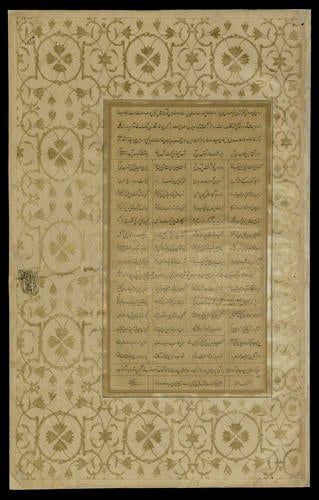
Abd al-Hamid Lahawri
Master: Padshahnamah پادشاهنامه (The Book of Emperors) Item: Text block of the Padshahnama manuscript 1656-57
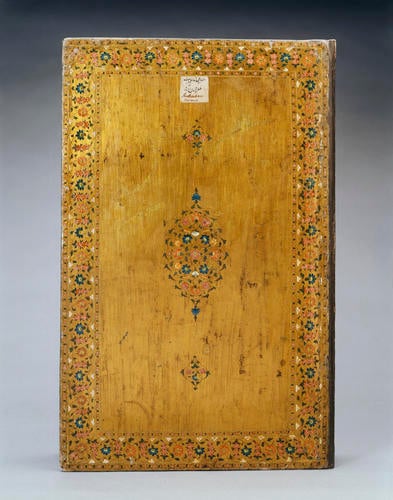
Abd al-Hamid Lahawri
Master: Padshahnamah پادشاهنامه (The Book of Emperors) Item: Padshahnamah manuscript covers 1656-57
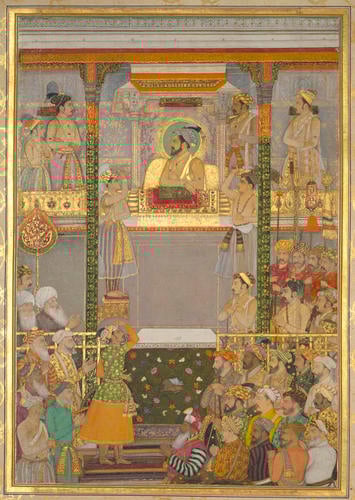
Abd al-Hamid Lahawri
Master: Padshahnamah پادشاهنامه (The Book of Emperors) Item: Shah-Jahan honouring Prince Awrangzeb at Agra before his wedding (27 April 1637) 1656-57
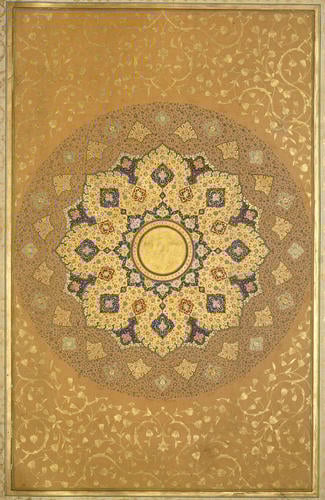
Abd al-Hamid Lahawri
Master: Padshahnamah پادشاهنامه (The Book of Emperors) Item: The Padshahnamah : opening shamsah (sunburst) 1656-57
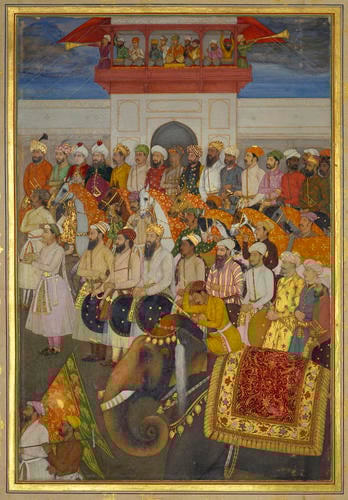
Abd al-Hamid Lahawri
Master: Padshahnamah پادشاهنامه (The Book of Emperors) Item: Jahangir receives Prince Khurram on his return from the Deccan (10 October 1617) 1656-57
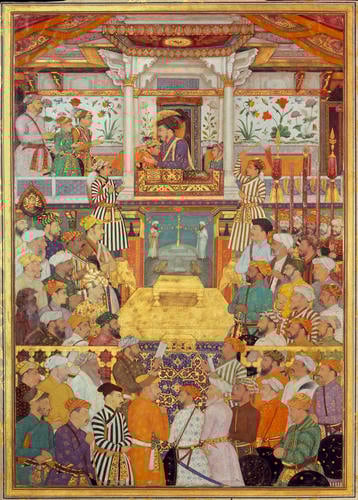
Abd al-Hamid Lahawri
Master: Padshahnamah پادشاهنامه (The Book of Emperors) Item: Shah-Jahan receives his three eldest sons and Asaf Khan during his accession ceremonies (8 March 1628) 1656-57
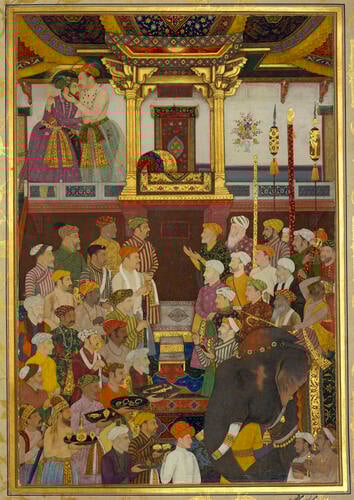
Abd al-Hamid Lahawri
Master: Padshahnamah پادشاهنامه (The Book of Emperors) Item: Jahangir receives Prince Khurram on his return from the Deccan (10 October 1617) 1656-57
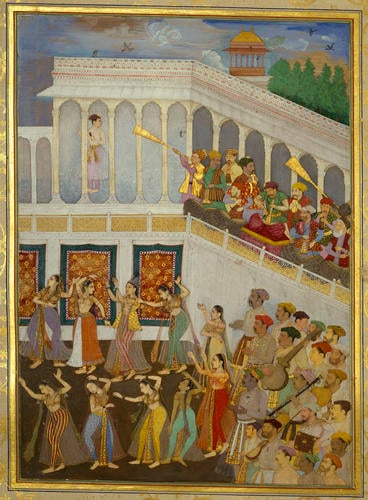
Abd al-Hamid Lahawri
Master: Padshahnamah پادشاهنامه (The Book of Emperors) Item: The Weighing of Shah-Jahan on his 42nd lunar birthday (23 October 1632) 1656-57
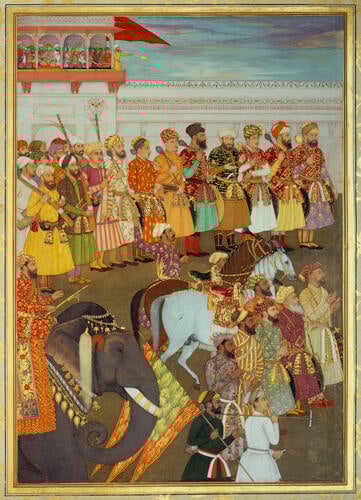
Abd al-Hamid Lahawri
Master: Padshahnamah پادشاهنامه (The Book of Emperors) Item: Shah-Jahan receives his three eldest sons and Asaf Khan during his accession ceremonies (8 March 1628) 1656-57
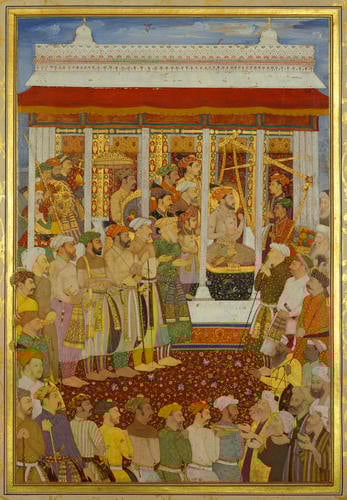
Abd al-Hamid Lahawri
Master: Padshahnamah پادشاهنامه (The Book of Emperors) Item: The Weighing of Shah-Jahan on his 42nd lunar birthday (23 October 1632) 1656-57
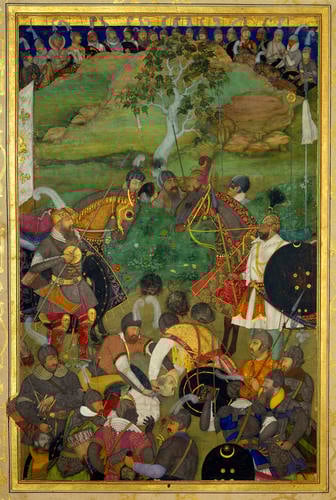
Abd al-Hamid Lahawri
Master: Padshahnamah پادشاهنامه (The Book of Emperors) Item: The Decapitation of Khan Jahan Lodi (3 February 1631) 1656-57
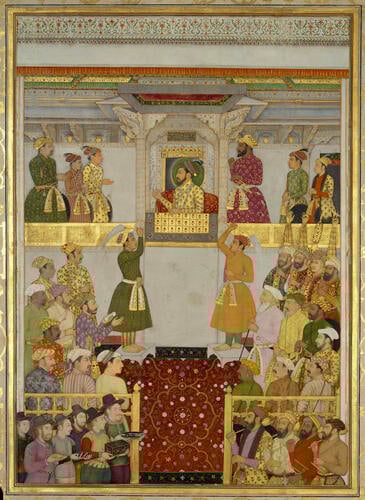
Abd al-Hamid Lahawri
Master: Padshahnamah پادشاهنامه (The Book of Emperors) Item: Europeans bring gifts to Shah-Jahan (July 1633) 1656-57
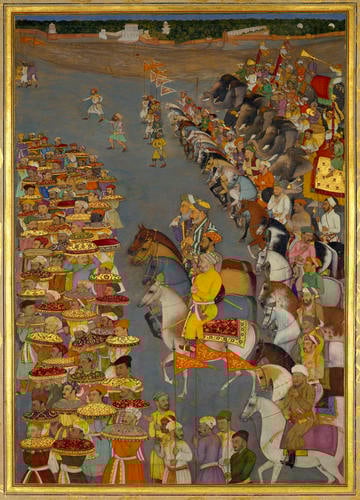
Abd al-Hamid Lahawri
Master: Padshahnamah پادشاهنامه (The Book of Emperors) Item: The Delivery of presents for Prince Dara-Shikoh's wedding (November-December 1632) 1656-57
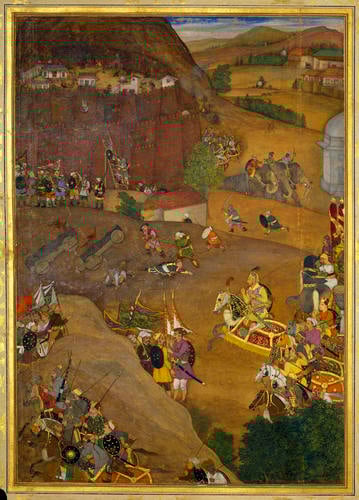
Abd al-Hamid Lahawri
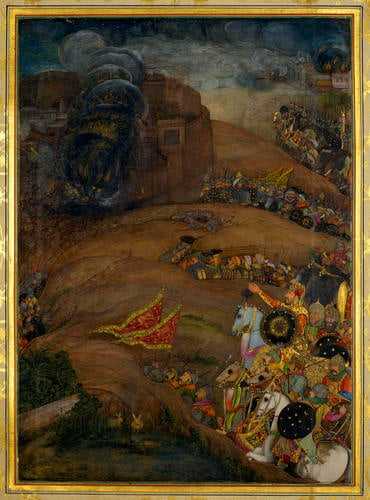
Master: Padshahnamah پادشاهنامه (The Book of Emperors) Item: Azam Khan captures Fort Dharur (January 1631) 1656-57
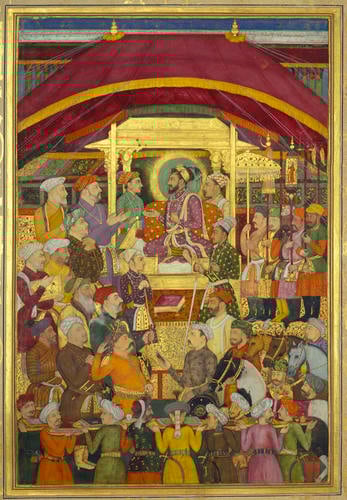
Abd al-Hamid Lahawri
Master: Padshahnamah پادشاهنامه (The Book of Emperors) Item: Shah-Jahan receives the Persian ambassador, Muhammad-Ali Beg, during the New Year celebrations (March 1631) 1656-57
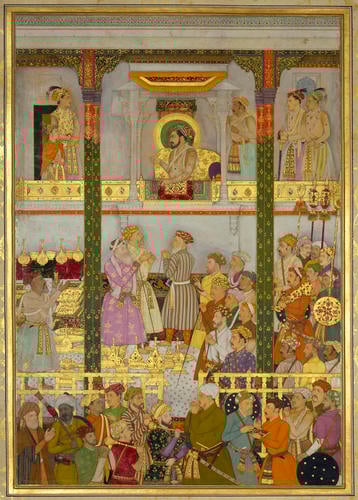
Abd al-Hamid Lahawri
Master: Padshahnamah پادشاهنامه (The Book of Emperors) Item: The exhibition of New Year gifts (March 1631) 1656-57
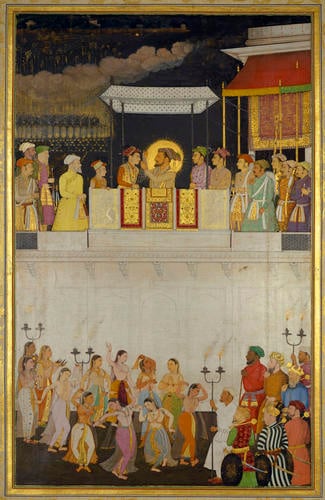
Abd al-Hamid Lahawri
Master: Padshahnamah پادشاهنامه (The Book of Emperors) Item: Shah-Jahan honouring Prince Dara-Shukoh at his wedding (12 February 1633) 1656-57
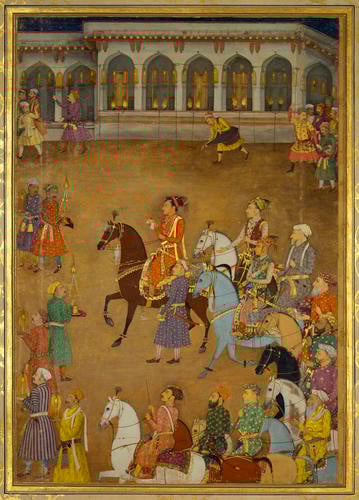
Abd al-Hamid Lahawri
Master: Padshahnamah پادشاهنامه (The Book of Emperors) 1656-57

-
The Padshahnamah (‘Book of the Emperor’) is an illustrated chronicle of the reign of Shah Jahan (r.1628-1658), the fifth Mughal emperor, who commissioned it as a celebration of his reign and dynasty. The text is a detailed chronological narrative of the emperor’s reign, describing his daily activities, court ceremonies and the honours he bestowed upon the members of nobility.
This manuscript is a unique survival, being the only contemporary illustrated imperial Padshahnamah volume still extant. It is the first volume of a set of three; the second and third having been lost. It comprises a preface, Shah Jahan’s horoscope, an account of the Mughal imperial genealogy from Timur (d.1405) to Jahangir (r.1605-27), and a discourse on the first decade of Shah Jahan’s rule. The volume ends with an epilogue listing in hierarchical order the nobles, officials, and religious figures who feature in the narrative.
The author, Abd al-Hamid Lahawri, wrote the Persian text as a combination of prose and verse using an ornate style full of complex allegories and flowery metaphors. His preface calls it ‘an adorned text, the description of which fills the listener’s dress with jewels’.
The colophon (f.239r) gives the name of the calligrapher and the date of the manuscript’s completion: ‘the slave, the poor / the sinful, Muhammad Amin of Mashhad 1067’ AH (AD 1656-57). Muhammad Amin was an Iranian émigré to the Mughal court who was already in his 70s by the time he was copying this. He wrote the text in nastaliq script using black and gold ink on heavily burnished brown paper, densely flecked with gold paint.
The opening pages of the manuscript are decorated with a pair of illuminated shamsahs (‘sunbursts’) symbolising divine light (see RCINs 1005025.a and 1005025.b), followed by an illuminated double-page frontispiece with portraits of Shah Jahan and his predecessor, Timur. When considered together, the images imply that Timur, the great ruler of Central Asia, is passing the imperial Timurid crown to Shah Jahan (see RCINs 1005025.c and 1005025.d). The manuscript’s outer borders of pale brown paper date to the early 17th century and are ornamented with a trellis design of freehand gold illumination. Rulings in opaque watercolour and gold paint cover the joint between the text pages and the borders.
The paintings in this manuscript are among the most refined examples of Mughal art ever produced. They portray significant events in Shah Jahan’s life – magnificent durbars, lavish processions, and glorious victories on the battlefield – and can all be dated to the 1630s, 1640s and 1650s. They were painted on single leaves and inserted into the text block, at the appropriate places in the narrative. Some of the paintings are signed by Shah Jahan’s artists (Abid, Balchand, Bichitr, Bishan Das, Payag, Dawlat, Bulaqi, Bhola and Murar) and many include their self-portraits.
The heading at the beginning of the text was outlined but never completed. This suggests that the manuscript’s decoration ceased suddenly around 1658. The lack of imperial inscriptions or seal impressions at the centre of the shamsahs, which are usually found in volumes completed for Shah Jahan, indicates that the volume never officially entered the emperor’s library. Similarly, dedications to the emperor in the colophon are noticeably absent, perhaps because this volume was intended as the first of a three-volume commission. Saqib Baburi (Beyond the Akbarnama, 2012) suggests that the manuscript’s current form dates to the reign of Farrukh-Siyar (r.1713-19), who saw himself as the second Shah Jahan. It is likely that the margins, inside covers, and the loose explanatory sheets between the paintings date from this period. Only four seal impressions (on the shamsah folios and the reverse of the final folio), now largely obscured, were made prior to the manuscript’s purchase by Asaf al-Daula, the Nawab (ruler) of Awadh in the 1780s. His black seal impression is at the centre left edge of each folio.
Following Asaf al-Daula’s death in 1797, his son Ali ruled for four months before he was deposed at the intervention of Sir John Shore (later Lord Teignmouth), Governor-General of Bengal (1793-98). Asaf al-Daula’s brother, Saadat Ali Khan, was then installed as Nawab of Lucknow in early 1798. It was at this time that Saadat Ali Khan presented this copy of the Padshahnamah and five other manuscripts (RCINs 1005015, 1005017, 1005022, 1005032 and 1005068) from the royal library in Lucknow to Lord Teignmouth, all intended as gifts for George III and shipped by Teignmouth from Calcutta (now Kolkata). Once in England, the manuscripts were brought to The King’s Library in Buckingham House (now Buckingham Palace), and moved to the Royal Library at Windsor in the 19th century.
In a note for George III regarding this gift (RCIN 1005091), Lord Teignmouth described the Padshahnamah thus: ‘This is the most splendid Persian manuscript I ever saw. Many of the faces are very well painted & some of them are portraits. The first is a portrait of Timur or Tamerlane, & the second that of Shahjehan. This was the Book which was shown to me at Lucknow, & I was then informed that the deceased Nabob Asoph uddoulah purchased it for 12000 [?] Rupees – about £1500.’
Binding description
The manuscript was re-bound at least twice in its history. The former binding (or re-binding) may date to the first quarter of the 18th century: the inner covers and parts of the leather spine date to this period. The text was sewn in three parts at this point, but damage to the spine (likely due to the pressure caused by such a heavy manuscript) led to its rebinding in five parts, likely in the 1780s, with the addition of new outer covers (see RCIN 1005025.av).
The manuscript was disbound in 1993, with the paintings mounted individually and the text block preserved separately.
Further Reading
Milo Beach and Ebba Koch, King of the World: the Padshahnama, an Imperial Mughal Manuscript From the Royal Library (Windsor Castle, 1996).
Saqib Baburi, Beyond the Akbarnama: Padshahnamahs and Official Regnal Chronography for Shah-Jahan Padshah (r. 1037/1628-1068/1658), unpublished PhD dissertation (SOAS University of London, 2012).Provenance
Mughal imperial library in the 1530s-1780s; Asaf al-Daula (1748-1797); royal library at Lucknow by 1798; presented by Lucknow’s ruler to John Shore, Lord Teignmouth (1751-1834) for George III in 1798.
-
Creator(s)
(calligrapher)(illustrator)(illustrator)(illustrator)(illustrator)(illustrator)(illustrator)(illustrator)(illustrator)(illustrator)(illustrator)(illustrator)(illustrator)(illustrator)(illustrator)(artist)(nationality)Acquirer(s)
-
Measurements
58.6 x 36.8 cm (book measurement (conservation))
Category


