


-
1 of 253523 objects
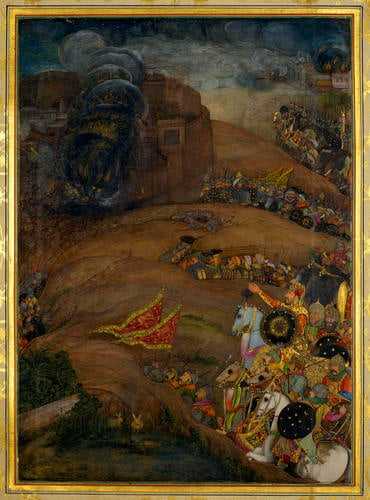
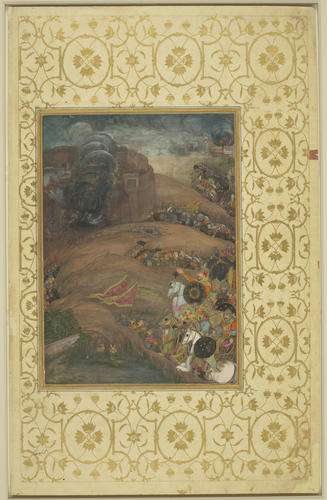
Nasiri Khan conquers the Fort at Qandahar (May 1631) c. 1635-50
Painting in opaque watercolour including metallic paints. | 32.1 x 23.0 cm (image) | RCIN 1005025.s
Payag
Master: Padshahnamah پادشاهنامه (The Book of Emperors) Item: Nasiri Khan conquers the Fort at Qandahar (May 1631) c. 1635-50
Payag
Master: Padshahnamah پادشاهنامه (The Book of Emperors) Item: Nasiri Khan conquers the Fort at Qandahar (May 1631) c. 1635-50
Payag
Master: Padshahnamah پادشاهنامه (The Book of Emperors) Item: Nasiri Khan conquers the Fort at Qandahar (May 1631) c. 1635-50
-
Padshahnamah fol. 102v
(plate 18)
The Mughal commander Nasiri Khan conquers the Fort at Qandahar (north-west of Hyderabad in the Deccan), in May 1631.
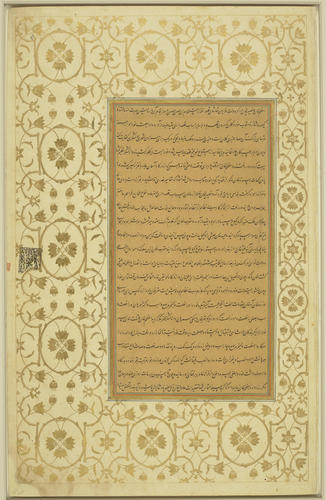
Despite Shah-Jahan’s successes in the Deccan as a Prince, the area remained resistant to Mughal control during the early years of his reign. A renewed campaign saw Dharur (also known as Fathabad) fall to Shah-Jahan’s forces in January 1631 (see RCIN 1005025.p) followed by Qandahar, a fortress ‘famed for its strength and impregnability’ after a four-month siege. This painting shows the detonation of three mines filled with gunpowder laid by Mughal forces under the outer walls of the fort. The principal figure on horseback, gesturing towards the fort, is the Mughal general Azam Khan. The Padshahnamah text records: 'While preparations were being made to take the stronghold, Azam Khan arrived in the vicinity. Nasiri Khan went out to greet him and then took him to watch the fortress being blown up, and in his presence the three mines that had been filled with gunpowder were lit.' Half of a tower was blown up and, according to the text, ‘the men who were in the tower and at the base of the wall were dispatched to hell.’ The battle continued from noon until dusk with Mughal soldiers attacking the fortress as they were fired at from within.
The artist Payag was the younger brother of another of Shah-Jahan’s painters, Balchand (see RCIN 1005025.p), and inscribed a shied in the foreground of the painting: ‘drawn by Payag’. Like his brother, Payag inserted emotional realism into the scene to emphasise the human experience of battle. Some soldiers react in horror to the burning men falling from the fort and figures shown transforming from charred bodies to almost translucent skeletons. Two rabbits huddle amongst the reeds beside a small pond in the foreground, seemingly oblivious to the scene behind them.
Bibliography:
Milo Beach and Ebba Koch, King of the world : the Padshahnama, an imperial Mughal manuscript from the Royal Library, Windsor Castle, 1996
Saqib Baburi, Beyond the Akbarnamah: Padshahnamahs and Official Regnal Chronography for Shah-Jahan Padshah (r. 1037/1628-1068/1658), 2010.Provenance
Illustration from a Padshahnamah manuscript formerly in the Mughal imperial library and acquired by Asaf al-Dawlah, Nawab of Awadh, c.1780-90; presented by Saadat Ali Khan, Nawab of Awadh, to George III via Lord Teignmouth in June 1799.
-
Creator(s)
(illustrator)Acquirer(s)
-
Medium and techniques
Painting in opaque watercolour including metallic paints.
Measurements
32.1 x 23.0 cm (image)
58.5 x 37.0 cm (page dimensions)
Category
Alternative title(s)
The Siege of Qandahar (May 1631)


