

-
1 of 253523 objects
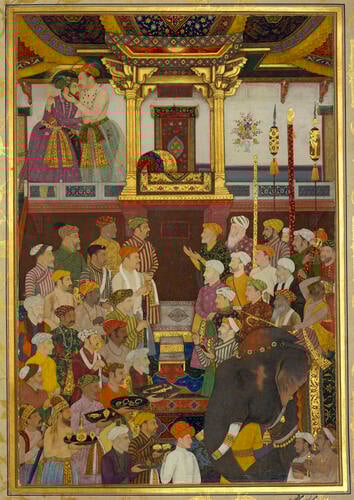
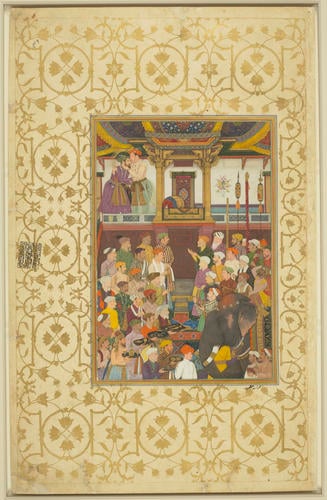
Jahangir receives Prince Khurram on his return from the Deccan (10 October 1617) c. 1630-50
Painting in opaque watercolour including metallic paints. | 30.8 x 20.9 cm (image) | RCIN 1005025.j
Murar
Master: Padshahnamah پادشاهنامه (The Book of Emperors) Item: Jahangir receives Prince Khurram on his return from the Deccan (10 October 1617) c. 1630-50
Murar
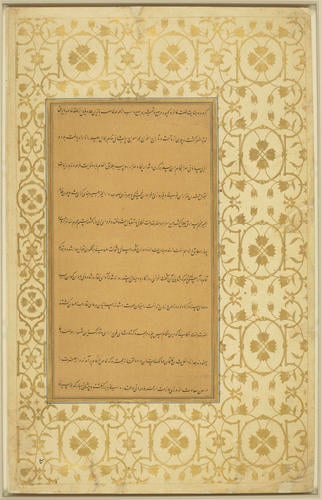
Master: Padshahnamah پادشاهنامه (The Book of Emperors) Item: Jahangir receives Prince Khurram on his return from the Deccan (10 October 1617) c. 1630-50
Murar
Master: Padshahnamah پادشاهنامه (The Book of Emperors) Item: Jahangir receives Prince Khurram on his return from the Deccan (10 October 1617) c. 1630-50
-
Padshahnamah fol. 49r
(plate 9)
Jahangir greets Prince Khurram at the court in Mandu on 10 Oct 1617 following the prince’s return from Deccan.
After Prince Khurram defeated the Rajput forces of Mewar, he led the Mughal forces against the armies of the Muslim rulers of the Deccan. This painting depicts a rare breach of protocol as Jahangir stood up and left his seat to embrace his son. The presentation of gifts from the defeated Deccani rulers is depicted in the foreground.
During Jahangir’s reign, the rise of Malik Ambar, an Ethiopian general at the court of Ahmednagar, thwarted the Mughal advancement into the Deccan. The Emperor moved the court from Ajmer to Mandu, the former palace of the Malwa sultans, in 1616 and appointed Prince Khurram to lead the Mughal forces in their campaigns. He achieved a temporary victory in 1617 when Malik Ambar and Ibrahim Adil Shah of Bijapur surrendered to the Mughal prince.
Two Deccani nobles in distinctive tall turbans bring gifts from Ibrahim Adil Shah of Bijapur including the elephant, whose rider also wears a Deccani turban. Five Mughal officers, including Afzal Khan Allami and Rajah Bikramjit, who negotiated the treaty of surrender, carry trays of jewelled daggers, rings, bracelets, jewelled ornaments, jewel encrusted gold cups, bowls, bottles and boxes on black lacquer trays. Also present are the Prime Minister, Itimad al-Dawlah, and his son Asaf Khan; and Jahangir’s brother-in-law, Rajah Suraj Singh Rathore, from the ruling family of Jodhpur.
At the centre of the painting, in the area of wall below the jharoka balcony, the artist sketched an allegorical image of bad government: a Mughal official offering a portly mullah a bag of coins while another drives away a starving beggar with his staff. This vignette may be a refer to the potential corruption and religious decline when the Mughal Emperor is not in his proper place (i.e. enthroned on the jharoka balcony), or alternatively to the claim that when Shah-Jahan became Emperor, he was a mujaddid (renewer) who restored justice to the empire after decades of misrule under his father.
The artist Murar signed the work on step under the Emperor ‘the work of the poor, destitute Murar’, and in the lower right corner painted a self-portrait with his paintings folder. Two drawings closely related to the painting exist in the British Library (Johnson Album 4, f.2) and the San Diego Museum of Art (1990.351).
Bibliography:
Milo Beach and Ebba Koch, King of the world : the Padshahnama, an imperial Mughal manuscript from the Royal Library, Windsor Castle, 1996
Saqib Baburi, Beyond the Akbarnamah: Padshahnamahs and Official Regnal Chronography for Shah-Jahan Padshah (r. 1037/1628-1068/1658), 2010.Provenance
Illustration from a Padshahnamah manuscript formerly in the Mughal imperial library and acquired by Asaf al-Dawlah, Nawab of Awadh, c.1780-90; presented by Saadat Ali Khan, Nawab of Awadh, to George III via Lord Teignmouth in June 1799.
-
Creator(s)
(illustrator)Acquirer(s)
-
Medium and techniques
Painting in opaque watercolour including metallic paints.
Measurements
30.8 x 20.9 cm (image)
58.2 x 36.8 cm (page dimensions)
Category


