


-
1 of 253523 objects
Jahangir receives Prince Khurram on his return from the Mewar campaign (19 February 1615) c. 1630-50
Painting in opaque watercolour including metallic paints. | 30.4 x 20.1 cm (image) | RCIN 1005025.f
Balchand
Master: Padshahnamah پادشاهنامه (The Book of Emperors) Item: Jahangir receives Prince Khurram on his return from the Mewar campaign (19 February 1615) c. 1630-50
Balchand
Master: Padshahnamah پادشاهنامه (The Book of Emperors) Item: Jahangir receives Prince Khurram on his return from the Mewar campaign (19 February 1615) c. 1630-50
Balchand
Master: Padshahnamah پادشاهنامه (The Book of Emperors) Item: Jahangir receives Prince Khurram on his return from the Mewar campaign (19 February 1615) c. 1630-50
-
Padshahnamah fol. 43v
(plate 5)
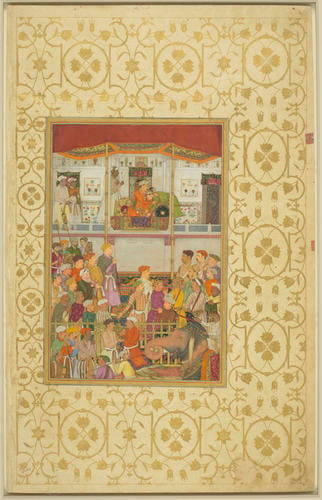
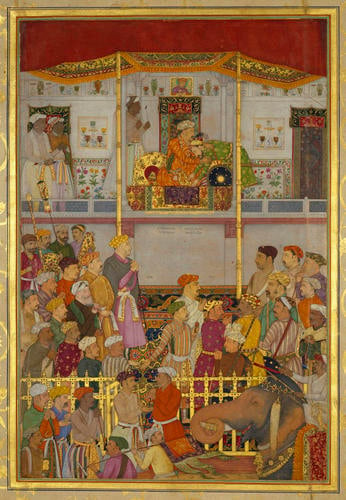
Prince Kurram (later Shah-Jahan) paying homage to his father Emperor Jahangir at the court in Ajmer in February 1615,
The first of eleven durbar (court assembly) scenes in the Padshahnamah manuscript, this painting accompanies the part of the text when Shah-Jahan receives news of the death of Rana Karan Singh of Mewar, and he reminisces about the submission of Mewar to him when a prince. The event depicted took place two weeks after his successful campaign against the Mewar army. Karan Singh, the eldest son of Rana Amar Singh of Mewar, in a yellow robe, is brought before the Mughal Emperor to pay homage on the Rana’s behalf.
Emperor Jahangir moved the Mughal court to Ajmer from 1613 until 1616 specifically to support the imperial troops in their war against the Hindu Rajput rulers of Mewar. The Rana of Mewar was the most important in the Rajput hierarchy and Prince Khurram’s defeat over Amar Singh’s forces was vital in ensuring that the Rajput courts acknowledged Mughal overlordship. Prince Khurram’s successful campaign also strengthened his prospects of becoming the next Emperor since the Mughals did not practice the custom of primogeniture. Jahangir bestowed on him the title Shah-Jahan (‘King of the World’) soon afterwards.
The scene takes place in the tented audience hall at Ajmer. Prince Khurram still wears his sword and shield as he leans down to touch the feet of his father who embraces him. Shown above them is an image of Jahangir’s father and Khurram’s grandfather, Emperor Akbar, holding a turban ornament. Both Jahangir and Khurram wear plumes in their turbans, emblems of royalty, and, when read with together with Akbar’s turban ornament, the three represent Mughal dynastic continuity. Depicted on the balcony with them are three eunuchs: Itibar Khan, holing a yak tail whisk and a staff topped with the figure of a hoopoe, the prophetic bird of King Solomon mentioned in the Quran; Firoz Khan, the chief eunuch, and Khidmat Khan.
The courtiers standing below the balcony are divided into two groups: on the right, Karan Singh is brought in by the military official Sadiq Khan and surrounded by men in Khurram’s service. On the left are the imperial standard bearers and the most important ministers and noblemen of Jahangir’s court including the Prime Minister, Itimad al-Dawlah, and his son Asaf Khan. Outside the jewel-encrusted gold railings are lower ranking courtiers as well as the flag bearer and the elephant that accompanied Karan Singh to the audience hall. At the bottom left is a self-portrait of the artist, Balchand, wearing a plain brown jama in contrast to the richly embroidered textiles he depicted the other figures wearing.
Balchand painted this scene some twenty years after the event depicted. He and his brother Payag had worked at the Mughal court since the 1590s and may have been attached to the court when at Ajmer. He signed his name on this painting below the Emperor’s balcony, underneath a poem in Persian that reads:
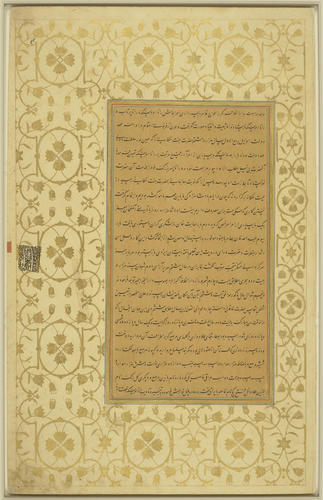
May the praise of Shah Jahan be the litany of those who keep watch at night
May prayers for his fortune be the litany of those who rise at dawn.
Wherever he draws his sword, like the solitary horseman of the sun
May the army of his foes be dispersed like the stars.
The artist also inscribed this poem onto a painting in the Chester Beatty Library depicting Shah-Jahan and his sons standing on the globe (CBL In 07A.10).
Bibliography:
Milo Beach and Ebba Koch, King of the world : the Padshahnama, an imperial Mughal manuscript from the Royal Library, Windsor Castle, 1996
Saqib Baburi, Beyond the Akbarnamah: Padshahnamahs and Official Regnal Chronography for Shah-Jahan Padshah (r. 1037/1628-1068/1658), 2010.Provenance
Illustration from a Padshahnamah manuscript formerly in the Mughal imperial library and acquired by Asaf al-Dawlah, Nawab of Awadh, c.1780-90; presented by Saadat Ali Khan, Nawab of Awadh, to George III via Lord Teignmouth in June 1799.
-
Creator(s)
(illustrator)Acquirer(s)
-
Medium and techniques
Painting in opaque watercolour including metallic paints.
Measurements
30.4 x 20.1 cm (image)
58.3 x 36.8 cm (page dimensions)
Category


